
Kansas DOV Permit Practice Test 7
Test 7 of 10. Pick an answer for each question to see if it is right and why; your score appears at the end. You need 20 correct answers to pass, the same ratio as the real Kansas test.
- Questions25
- Correct to pass20
- Passing score80%
- Minimum age14 years
-
1. You are passing a line of slow traffic in the lane beside you and you notice a gap in that line ahead. What should you expect?
Show answer
Answer A: A vehicle may pull out of that gap into your lane
A gap in a slow line is an invitation to any driver waiting to turn out of a side street or to change lanes, and they are looking at the gap rather than at you.
-
2. On a Kansas highway with two or more lanes in your direction, what must you do when approaching a stationary emergency vehicle using visual signals?
Show answer
Answer D: Proceed with due caution and, if possible and safe, change into a lane that is not adjacent to it
K.S.A. 8-1530 requires a driver on a multilane highway to proceed with due caution and, when possible and safe, change into a lane not adjacent to the stationary emergency vehicle, or otherwise slow to a safe speed.
-
3. What fee does Kansas charge for a replacement driver's license after the original is lost or destroyed?
Show answer
Answer B: 8 dollars
K.S.A. 8-246 sets a flat 8 dollar fee for a replacement license, along with proof of the loss and of identity.
-
4. You are about to pass another vehicle at night with your high beams on. What should you do?
Show answer
Answer C: Switch to low beams as you come up behind it and while you are alongside
High beams shining into the mirrors of the vehicle ahead blind the very driver whose reaction you depend on during the pass.
-
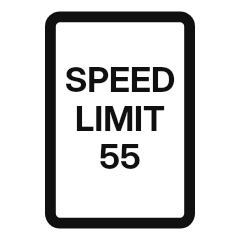
5. A driver passes this sign on an open road. Over what stretch does the figure it sets stay in force?
Show answer
Answer A: From the sign onward, in every lane, until another sign sets a different figure
The figure governs the road from the sign onward and binds every lane, and it stays in force until a later sign sets a different one.
-
6. When may a Kansas driver type a text message without breaking the written communication ban?
Show answer
Answer C: When the vehicle is stopped off the regular traveled portion of the roadway
K.S.A. 8-15,111 exempts a motor vehicle stopped off the regular traveled portion of the roadway.
-
7. Who may apply to the Kansas Division of Vehicles for a farm permit?
Show answer
Answer D: Any person at least 14 but under 17 who lives on a Kansas farm or works on one for pay
K.S.A. 8-296 opens the farm permit to a person at least 14 and under 17 who either resides upon a Kansas farm or is employed for compensation upon one.
-
8. What is the youngest age at which a person may apply to the Kansas Division of Vehicles for an instruction permit?
Show answer
Answer A: 14 years
K.S.A. 8-2,100 lets a person who is at least 14 but less than 17 years old apply for an instruction permit, with a written application from a parent or guardian for applicants under 16.
-
9. How does Kansas make a driver's license issued to a person under 21 readily distinguishable?
Show answer
Answer A: By using a vertical format
K.S.A. 8-243 directs the secretary of revenue to use a vertical format so licenses issued to people under 21 stand out.
-
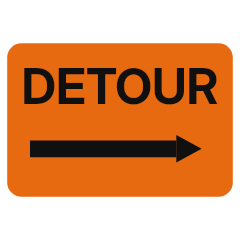
10. Which of these is true of the roadway a driver is being sent onto here?
Show answer
Answer D: Its own signs, signals and speed limits govern for the whole way around
The alternate route is an ordinary public road, so every control posted on it governs as usual; being sent that way grants no extra priority and no relief from the limits in force there.
-
11. Under the Kansas farm permit law, what counts as a farm?
Show answer
Answer B: Any parcel of land larger than 20 acres used in agricultural operations
K.S.A. 8-296 defines farm for the farm permit as any parcel of land larger than 20 acres which is used in agricultural operations.
-
12. You are turning left across tracks that run along the center of the street. What should you do before crossing them?
Show answer
Answer B: Look along the tracks in both directions and cross only when clear
Rail vehicles running in the street can arrive from either direction and cannot stop quickly, so look along the tracks before you turn across them.
-
13. Enhanced reference location markers differ from ordinary mileposts in that they
Show answer
Answer B: carry the route number and a mileage figure to the tenth of a mile
An enhanced reference location marker adds the route designation and carries the mileage to a tenth, so the point named is far more precise than a plain milepost.
-
14. What is the minimum total light transmission Kansas allows where a sun screening device is used on a vehicle window?
Show answer
Answer D: 35 percent
K.S.A. 8-1749a requires total light transmission of not less than 35 percent where a sun screening device is used with other existing devices.
-
15. Compared with dry pavement, how much room does a vehicle need to stop on packed snow?
Show answer
Answer D: Several times as much
Grip on packed snow is a fraction of that on dry pavement, so stopping distance grows several times over. Antilock brakes help you steer, not stop shorter.
-
16. Where a Kansas traffic misdemeanor carries no penalty class of its own, how is a second such offense within one year of the first classified?
Show answer
Answer C: A class B misdemeanor
K.S.A. 8-2116 makes an unclassified traffic misdemeanor a class C misdemeanor, rising to class B on a second offense within a year of the first.
-
17. What does Kansas law say about a flagger directing traffic in a road construction zone?
Show answer
Answer C: It is unlawful to fail to comply with the flagger's traffic orders or directions
K.S.A. 8-1531a makes it unlawful to fail, neglect or refuse to comply with traffic orders or directions given by a flagman in a road construction zone.
-
18. What does a sign reading Slower Traffic Keep Right require?
Show answer
Answer C: Traffic moving slower than the general flow must use the right-hand lane
The sign applies to any vehicle traveling below the speed of the traffic around it, which must keep right so faster vehicles can use the lanes to the left.
-
19. How does a lap and shoulder belt protect you in a crash?
Show answer
Answer B: It holds you to the seat and spreads the force over the strong bones
The belt keeps you with the vehicle as it slows and puts the load on the hips and the chest rather than on soft tissue.
-
20. You are crossing a divided highway with a wide median. How should you treat the two roadways?
Show answer
Answer D: As two intersections, waiting in the median only when your vehicle fits
Each roadway of a divided highway is a separate intersection, and you should wait in the median only if it is long enough to hold your vehicle clear of both roadways.
-
21. On a Kansas highway posted between 55 and 75 miles per hour, how far over the limit may a speeding conviction go before it is treated as a moving traffic violation?
Show answer
Answer D: 10 miles per hour
K.S.A. 8-1560c excludes an overage of not more than 10 miles per hour on a highway posted at 55 to 75 miles per hour from the definition of a moving violation.
-
22. You are approaching a narrow bridge where the road has one lane in each direction and no shoulder. What should you do about passing?
Show answer
Answer B: Do not pass on or near the bridge
A narrow bridge gives neither vehicle anywhere to go, so passing is prohibited there in the same way as on a hill or in a tunnel.
-
23. A sign at the start of an exit ramp shows a speed much lower than the highway limit. What does it apply to?
Show answer
Answer C: The curve of the ramp itself, once you have left the highway
The ramp speed is set by the sharpness of the ramp curve, so you slow to it inside the deceleration lane rather than out on the highway.
-
24. A notification appears on your smart watch while you are driving. What should you do?
Show answer
Answer B: Treat it as you would a phone and leave it
A watch screen demands the same eyes and the same attention as a phone, and a wrist is no safer a place to read a message than a dashboard.
-
25. What is the most common cause of rear-end collisions?
Show answer
Answer C: Following too closely to stop in time
A driver who leaves too little space has no room to perceive, react and brake when the vehicle ahead slows, which is why space management prevents rear-end crashes.