
Kansas DOV Permit Practice Test 1
Test 1 of 10. Pick an answer for each question to see if it is right and why; your score appears at the end. You need 20 correct answers to pass, the same ratio as the real Kansas test.

- Questions25
- Correct to pass20
- Passing score80%
- Minimum age14 years
-
1. Why is a U-turn on a one-way street a problem?
Show answer
Answer A: You would end up facing the wrong way against all the traffic
Every lane of a one-way street runs the same way, so turning around leaves you driving head-on against all of the traffic.
-
2. What administrative penalty applies on a first occurrence when a Kansas driver's blood or breath alcohol concentration is 0.15 or greater?
Show answer
Answer D: A one year suspension followed by one year of ignition interlock restriction
K.S.A. 8-1014 treats a first occurrence at 0.15 or greater far more severely, with a one year suspension and then a one year interlock restriction.
-
3. For an alert driver, about how long is the reaction time once a hazard has been recognized?
Show answer
Answer A: About three quarters of a second
Reaction alone takes roughly three quarters of a second for an alert driver, and perception takes about as long again, so a second and a half of travel is added before the brakes bite.
-
4. You park a manual transmission car facing uphill at a curb. What is the correct combination?
Show answer
Answer A: First gear, wheels turned away from the curb, parking brake set
Facing uphill the car would roll back, so first gear resists that, the wheels turned out let a tire catch the curb, and the parking brake holds it.
-
5. A flashing red lamp is mounted above a stop sign at a rural intersection. What does it add?
Show answer
Answer C: Emphasis, while the required stop stays the same
A stop beacon makes an easily missed stop sign more visible, but it neither adds to nor takes away from the obligation the sign already imposes.
-
6. You want to turn left across the oncoming lane into a shopping center driveway. Who must you yield to?
Show answer
Answer B: Oncoming traffic and anyone using the sidewalk
A left turn into a driveway crosses both the oncoming lane and the sidewalk, so you give way to traffic and to pedestrians before completing it.
-
7. A steady downward green arrow is displayed over a lane. What does it indicate?
Show answer
Answer C: The lane is open to traffic in your direction
A steady downward green arrow means the lane it points to is open to traffic traveling in your direction.
-
8. A sign warns that your exit leaves from the left side of the freeway. What should you do?
Show answer
Answer D: Move into the left lane in good time before you reach the exit
Left-hand exits are unusual, which is exactly why they are signed well in advance and why the lane changes should be finished early.
-
9. Along a highway the reference markers count upward as you travel. Where does the numbering normally begin?
Show answer
Answer C: At the southern or western edge of the state
Mileage numbering starts where the route enters the state from the south or the west, so rising numbers tell a driver which way they are heading.
-
10. What is the minimum age for a Kansas restricted class C driver's license?
Show answer
Answer B: 15 years
K.S.A. 8-2,101 allows a restricted class C or class M license at 15 years of age for an applicant who has completed approved driver training and held an instruction permit for at least one year.
-
11. What does Kansas do to the speeding fine of a driver convicted of exceeding the limit in a school zone?
Show answer
Answer D: Doubles it
K.S.A. 8-2118 doubles the scheduled speeding fine for a conviction of exceeding the maximum speed limit in a school zone.
-
12. A black on white regulatory sign at an intersection reads NO TURNS. What may a driver do there?
Show answer
Answer B: Only continue straight through the intersection
The NO TURNS sign bans turns in every direction at that intersection, so the only lawful movement from that approach is straight through.
-
13. You are driving on a road covered with a layer of wet fallen leaves. What should you expect?
Show answer
Answer B: As little grip as on ice, plus hidden markings and hidden holes
Wet leaves are as slippery as ice and they hide the lane lines and any potholes underneath, so slow well before curves and stops.
-
14. How close to a stationary authorized utility or telecommunications vehicle may a Kansas driver overtake and pass another vehicle?
Show answer
Answer A: No closer than 100 feet from it
K.S.A. 8-15,114 forbids overtaking and passing another vehicle when approaching within 100 feet of a stationary authorized utility or telecommunications vehicle.
-
15. Which vehicles did Kansas add to the move over duty in 2021 alongside emergency and highway work vehicles?
Show answer
Answer D: Authorized utility and telecommunications vehicles
K.S.A. 8-15,114 requires drivers to change lanes or slow down for a stationary authorized utility or telecommunications vehicle displaying flashing lights.
-
16. What is the uniform fine in Kansas for unlawful text messaging while driving?
Show answer
Answer B: 60 dollars
The uniform fine schedule in K.S.A. 8-2118 prices unlawful text messaging at 60 dollars.
-
17. What is the penalty class and minimum fine on a first Kansas conviction for driving while a license is suspended?
Show answer
Answer A: A class B nonperson misdemeanor with a fine of not less than 100 dollars
K.S.A. 8-262 makes a first conviction a class B nonperson misdemeanor and adds a fine of not less than 100 dollars.
-
18. The vehicle you want to pass is traveling close to the speed limit. What should you do?
Show answer
Answer C: Stay behind, because a pass may not take you over the limit
The speed limit applies while passing too. If you cannot complete the pass without exceeding it, do not start the pass.
-
19. How many motor vehicles must be registered in a person's name in Kansas before that person may seek a certificate of self-insurance?
Show answer
Answer B: More than 25
K.S.A. 40-3104 lets a person in whose name more than 25 motor vehicles are registered in Kansas qualify as a self-insurer through the commissioner of insurance.
-
20. What must a Kansas officer tell a driver about legal advice before requesting a breath test?
Show answer
Answer B: That there is no right to counsel on whether to submit, only afterward
K.S.A. 8-1001 requires notice that there is no right to consult an attorney about whether to submit, although one may be consulted once testing is finished.
-
21. Within what time after driving must a Kansas test reading of 0.08 or more be taken for that reading by itself to establish driving under the influence?
Show answer
Answer A: Three hours
K.S.A. 8-1567 covers an alcohol concentration of 0.08 or more measured within three hours of operating or attempting to operate a vehicle.
-
22. As a center two-way left-turn lane reaches an intersection, the markings change into a single left-turn lane. What does that mean for you?
Show answer
Answer D: From that point it serves one direction only, so use it just to turn left
Where the shared lane becomes a marked turn bay it belongs to one direction of travel, and only vehicles making that left turn may occupy it.
-
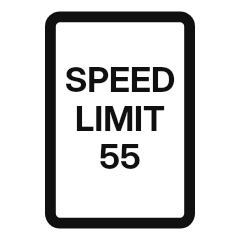
23. Heavy rain has left standing water on the road where this sign is posted. What does the law expect of the driver?
Show answer
Answer C: Driving below the posted figure, at a speed that suits the conditions
Drivers must adapt to conditions, so in rain, fog, snow or dense traffic the safe speed falls below the posted maximum and keeping to that maximum can itself be an offense.
-
24. By how much may a Kansas driver exceed a posted limit between 30 and 54 miles per hour before the conviction counts as a moving traffic violation?
Show answer
Answer B: By not more than 6 miles per hour
K.S.A. 8-1560c keeps a conviction for exceeding a posted limit of 30 to 54 miles per hour by not more than six miles per hour outside the definition of a moving violation.
-
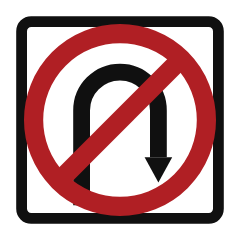
25. A driver who wants to reverse direction arrives at this sign. What is allowed?
Show answer
Answer C: Going on and reversing direction only where the maneuver is permitted
The restriction removes that maneuver at that spot entirely, so the driver has to continue and turn the vehicle around at a place where it is not prohibited.