
Kansas DOV Permit Practice Test 46
- Questions25
- Correct to pass20
- Passing score80%
- Minimum age14 years
-
1. What is the basic rule for entering a roundabout?
Show answer
Answer B: Traffic already circulating goes first, and you wait for a gap
Entering traffic yields to vehicles already going around the circle, which is what keeps a roundabout moving instead of locking up.
-
2. A flashing red arrow is displayed for your turning lane. What does it require?
Show answer
Answer D: Stopping, then turning when the way is clear
A flashing red arrow is treated like a stop sign for that movement: come to a full stop, then turn when it is safe and no one has to be cut off.
-
3. A regulatory sign posted at the start of a road reads LENGTH LIMIT 30 FEET. What does it control?
Show answer
Answer B: The overall length of vehicle allowed on that road
Some states post a length limit where tight curves or narrow structures lie ahead; it bars vehicles or combinations longer than the figure shown from using that road.
-
4. On traffic control devices, the color green shows direction to a destination and also shows
Show answer
Answer C: that a movement is permitted
Green carries two assignments: guidance toward destinations, and the idea that the movement shown is allowed, as on a green arrow.
-
5. Which part of the space around your vehicle can you control best?
Show answer
Answer A: The space ahead of you
You choose your own following distance, so the gap in front is the space you truly control and the one that gives you time to react.
-
6. How is the yield sign shaped and colored?
Show answer
Answer C: A downward-pointing triangle with a wide red border and a red legend on white
The yield sign is a downward-pointing equilateral triangle with a wide red border and the legend in red on a white background, an outline used for no other message.
-
7. Traffic in your lane is backed up and the paved shoulder looks clear. May you drive along it to get past?
Show answer
Answer C: No, the shoulder is not a travel lane
Passing must be done within the roadway; driving on the shoulder to get around traffic is prohibited and surprises anyone entering from the right.
-
8. You have turned onto a street and see parked cars facing you and headlights coming toward you. What has probably happened?
Show answer
Answer C: You have turned the wrong way onto a one-way street
Vehicles parked facing you and headlights approaching in your lane are the classic signs of driving against the flow on a one-way street.
-
9. How should the inside rearview mirror be adjusted?
Show answer
Answer B: So you can see the entire rear window without moving your head
The inside mirror is for the view straight behind you. Framing the whole rear window from your normal seating position gives the widest useful view.
-
10. Is dictating a message by voice a safe alternative to typing one?
Show answer
Answer C: No, it still takes attention from driving
Composing and checking a spoken message loads the mind and usually pulls the eyes to the screen anyway, so research finds it no safer than other phone use.
-
11. How does the blood alcohol standard for a driver operating a commercial vehicle compare with the one for a car driver?
Show answer
Answer D: It is lower, set at 0.04
Commercial drivers are held to a stricter standard of 0.04 because of the size of their vehicles and the risk they carry.
-
12. A yellow diamond showing two vertical arrows, one pointing up and one pointing down, warns that
Show answer
Answer A: the road ahead carries traffic in both directions
The two-way traffic sign warns that the roadway ahead is not divided and that vehicles will be coming from the opposite direction.
-
13. Under K.S.A. 8-237, what is the youngest age at which Kansas may issue a driver's license that is not a restricted class C or M license or a farm permit?
Show answer
Answer C: 17 years
K.S.A. 8-237 bars the Division of Vehicles from issuing a driver's license to a person under 17, except for a restricted class C or M license under K.S.A. 8-2,101 or a farm permit under K.S.A. 8-296. The graduated restrictions on the 16 year old restricted license themselves end after six months.
-
14. Your vehicle has stalled on railroad tracks and no train is in sight. After getting everyone away, whom should you call first?
Show answer
Answer B: The railroad emergency number posted on the blue sign at the crossing, giving the crossing number
Every public crossing has a blue emergency notification sign with a phone number and a crossing identification number. That call lets the railroad stop or slow trains before they reach you.
-
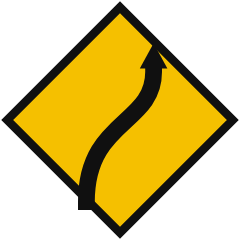
15. What does this sign tell a driver about the road ahead?
Show answer
Answer A: The roadway changes direction ahead, so speed should be reduced before reaching it
It gives advance notice of a change in alignment so the driver can slow down before entering, since braking inside a bend uses up grip that is needed for steering.
-
16. When should most of your braking for a turn be finished?
Show answer
Answer B: Before you begin to turn the wheel
Slow to the right speed before the turn begins; braking hard while turning uses up the grip the tires need for steering.
-
17. What should you expect while driving through a parking lot?
Show answer
Answer D: Pedestrians and vehicles moving from any direction, so drive slowly
Parking lots mix walking people, reversing vehicles and poor sight lines, so low speed and constant scanning are the only reliable protection.
-
18. A driver ahead brakes for no reason you can see, again and again. What should you do?
Show answer
Answer B: Increase your following distance and be ready for yet another stop
Unexplained braking tells you the driver is unsure or distracted, so the safe answer is more room, not less.
-
19. How does Kansas enforce the safety belt requirement for a back seat occupant who is 18 or older?
Show answer
Answer D: Officers may only cite it after stopping the vehicle for another violation
K.S.A. 8-2503 requires occupants 18 and older to be belted but states that officers shall not stop drivers for a back seat violation alone, and a citation must cite the violation that caused the stop.
-
20. You have a green arrow to turn left. What still applies?
Show answer
Answer D: You must yield to any pedestrian or vehicle still inside the intersection
A green arrow protects your turn from conflicting traffic, but you must still let anyone already in the intersection get clear before you move.
-
21. A lane along the right edge is set off by a solid white line and marked with a bicycle symbol. How should a driver treat it?
Show answer
Answer B: Stay out of it except for the short distance needed to turn or cross where that is allowed
A marked bicycle lane is set aside for bicycle traffic, and motor vehicles may enter it only briefly where turning or crossing is permitted.
-
22. You have fitted small convex blind spot mirrors to the door mirrors. What is true of them?
Show answer
Answer A: They help a good deal, but you should still look over your shoulder as well
Add-on mirrors reduce but do not remove the blind spot, and they make vehicles look smaller and further away.
-
23. A law enforcement officer is directing traffic and waves you forward while the signal facing you shows red. What should you do?
Show answer
Answer A: Follow the officer's direction and proceed
Directions given by an officer controlling traffic take priority over signals, signs and pavement markings.
-
24. A sign beside the signal reads STOP HERE ON RED. What does it tell you?
Show answer
Answer B: Stop at that point on red, not closer to the intersection
The sign marks the required stopping point, which is set back from the corner so that turning vehicles and sight lines are not blocked.
-
25. A large truck ahead of you swings toward the left just before turning right at an intersection. What should you do?
Show answer
Answer B: Stay back and never try to move into the gap between the truck and the curb
Long vehicles need extra room and often swing wide to complete a right turn, so the space that opens on their right closes again as the trailer sweeps through it.