
Kansas DOV Permit Practice Test 45
- Questions25
- Correct to pass20
- Passing score80%
- Minimum age14 years
-
1. You are about to change lanes to the left when you notice a vehicle already overtaking you in that lane. What should you do?
Show answer
Answer A: Hold your lane and your speed, and change only after that vehicle has gone by
A signal asks for space but does not create it, and the overtaking driver has nowhere to go if you move across.
-
2. What penalty does Kansas attach to a first conviction for operating a vehicle without motor vehicle liability insurance?
Show answer
Answer B: A class B misdemeanor, with a fine of 300 to 1,000 dollars or up to six months in jail
K.S.A. 40-3104 makes the offense a class B misdemeanor with a fine of not less than 300 nor more than 1,000 dollars, up to six months in jail, or both.
-
3. You are parking on a one-way street where parking is allowed on both sides. What must still be true?
Show answer
Answer D: The vehicle must face the direction the traffic flows
Either curb may be used on a one-way street where signs allow it, but the vehicle must always be headed in the direction traffic moves.
-
4. A sign on a long downgrade points to a runaway vehicle ramp. What is that ramp for?
Show answer
Answer C: Trucks that have lost braking ability on the grade
A runaway ramp is an escape lane of loose material that stops a heavy vehicle whose brakes have overheated or failed, so it must always be left clear.
-
5. You reach an uncontrolled intersection at the same moment as a vehicle approaching from your left. What should you do?
Show answer
Answer A: Proceed, but only once you see that driver slowing
You have the right of way over the vehicle on your left, but a right of way is something the other driver has to give, so confirm it before you commit.
-
6. You are traveling a long distance on a highway with three lanes in your direction, at about the speed of the surrounding traffic. Which lane is generally the best choice?
Show answer
Answer C: The center lane, which keeps you clear of merging traffic and of overtaking traffic
On a three-lane roadway the center lane avoids both the ramp traffic on the right and the overtaking traffic on the left, so it usually has the steadiest flow.
-
7. In slow summer traffic the temperature gauge climbs into the red. What should you do first?
Show answer
Answer A: Turn off the air conditioner and turn on the heater to draw heat from the engine
The heater core acts as an extra radiator, and shutting off the air conditioner reduces engine load. If the gauge keeps climbing, pull over and shut off the engine, and never open a hot radiator cap.
-
8. You have brought the vehicle under control after a blowout. What should you do next?
Show answer
Answer A: Signal and coast well off the road before stopping
Let the speed fall, signal, and leave the roadway as far from traffic as you can before you stop. Driving on a failed tire ruins the wheel and risks control.
-
9. What must a Kansas driver do before leaving a vehicle standing unattended on a grade?
Show answer
Answer D: Stop the engine, lock the ignition, remove the key, set the brake and turn the front wheels to the curb
K.S.A. 8-1573 requires stopping the engine, locking the ignition, removing the key and setting the brake, and on any grade also turning the front wheels to the curb or roadside.
-
10. A yellow pennant, an isosceles triangle with its long axis horizontal, is reserved for which message?
Show answer
Answer D: No passing zone
The pennant shape is used only for the no passing zone sign, which marks the point where overtaking is no longer allowed.
-
11. What must you be sure of before you pull out to pass on a two-lane road?
Show answer
Answer A: That the road ahead is clear far enough for the whole pass
You need enough clear road to pull out, pass and return before any oncoming vehicle arrives, and you must judge that distance before you start.
-
12. Your brake pedal sinks to the floor and the vehicle does not slow down. What is a reasonable sequence of actions?
Show answer
Answer C: Pump the pedal, shift to a lower gear and apply the parking brake gradually while steering to a safe spot
Pumping can rebuild pressure in a partly failed system, a lower gear adds engine braking, and easing on the parking brake slows the vehicle without locking the wheels.
-
13. What is the right speed for a normal right turn at a city corner?
Show answer
Answer C: Slow enough to hold your lane and stop for a pedestrian
A city right turn is tight and crosses a crosswalk, so the correct speed is one that keeps you inside your lane and still allows a stop.
-
14. Why is repeatedly changing lanes to work through heavy traffic a poor idea?
Show answer
Answer A: It raises the crash risk and saves almost no time
Each lane change adds a conflict with another vehicle, and in congestion the lanes move at similar average speeds, so the gain is negligible.
-
15. What actually lowers the amount of alcohol in a person's blood?
Show answer
Answer D: The passage of time
The body eliminates alcohol at its own steady rate, so only time reduces blood alcohol. Coffee or a cold shower may make a person feel more awake while still impaired.
-
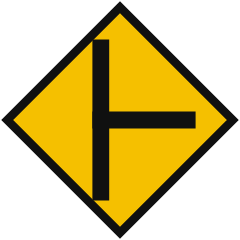
16. What condition does this sign warn a driver about?
Show answer
Answer B: Another road joins the road being traveled, from one side
It announces a side road entering the main roadway, so the driver should expect vehicles waiting to pull out and other vehicles slowing to turn in.
-
17. What should you check on the hitch before towing a trailer?
Show answer
Answer B: That the coupler is locked and the safety chains are crossed underneath
The coupler must be latched and pinned, and the chains crossed under the tongue so they cradle it if the coupling lets go.
-
18. At a rural intersection a beacon flashes yellow toward the main road and red toward the side road. How is each approach treated?
Show answer
Answer A: The main road slows and proceeds, the side road stops
An intersection control beacon assigns flashing yellow to the road with priority and flashing red to the approach that must stop and yield.
-
19. A sign on a long descent points to a RUNAWAY TRUCK RAMP a mile ahead. What is that ramp for?
Show answer
Answer C: Stopping a vehicle whose brakes have failed
An escape ramp climbs into deep gravel or sand to bring a vehicle with failed brakes to a halt, so no one should stop or park in it.
-
20. Two lanes at the corner are marked for right turns. What does that require of you?
Show answer
Answer A: Keep your own lane through the turn and into the matching new lane
Dual turn lanes work only if each vehicle stays in its own lane all the way round and finishes in the corresponding lane of the new street.
-
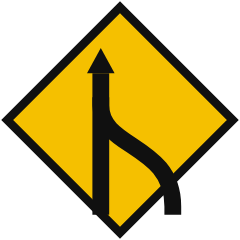
21. Why does the situation ahead of this sign deserve extra care from a motorcyclist?
Show answer
Answer C: Because a narrow machine is easy to overlook in a mirror or a blind spot
A motorcycle fills very little of a mirror and disappears easily into a blind spot, so the rider should adjust speed and lane position to stay visible where the streams come together.
-
22. You are traveling in the same direction as a funeral procession and want to get ahead of it. What should you not do?
Show answer
Answer B: Driving in between the vehicles of the procession
Most states prohibit driving into or through a funeral procession, and cutting into the line leaves the drivers behind with no lead vehicle to follow, so go around only where passing is permitted.
-
23. You are about to pass a long tractor-trailer on a two-lane road. What should you expect?
Show answer
Answer B: You will need more clear road, since the vehicle is much longer
A tractor-trailer can be 70 feet long, so passing it takes more distance and more time than passing a car at the same speed difference.
-
24. What is the first thing to do once your disabled vehicle is stopped on the shoulder?
Show answer
Answer A: Switch on the hazard warning lights so other drivers can see the vehicle
Hazard lights are the fastest way to make a stopped vehicle visible, and everything else can follow once traffic has been warned.
-
25. What does a blood alcohol concentration of 0.08 mean for the driver of a car?
Show answer
Answer B: It is the level almost every state treats as legally intoxicated
In almost every state a driver at 0.08 or above is legally intoxicated whatever the driver seems like, but impairment starts well before that level is reached.