
Kansas DOV Permit Practice Test 41
- Questions25
- Correct to pass20
- Passing score80%
- Minimum age14 years
-
1. Your right-turn lane shows a green arrow while the through lanes face a red ball. What does that mean?
Show answer
Answer C: Only the right turn is allowed, and it is protected while the arrow lasts
A green arrow gives a protected movement in that direction only; the red ball still stops the through traffic in the other lanes.
-
2. A preferential lane sign reads HOV 2+ and lists the hours it applies. During those hours, which vehicles may use the lane?
Show answer
Answer A: Vehicles carrying at least two people, counting the driver
The number on an HOV sign is the minimum number of occupants, driver included, that a vehicle must carry to use the lane while the restriction is in effect.
-
3. Alcohol is classified as which kind of drug?
Show answer
Answer B: A depressant that slows the central nervous system
As a depressant, alcohol slows the brain and nervous system, which lengthens reaction time and dulls the coordination that driving depends on.
-
4. A traffic signal is dark and you reach the intersection at the same moment as a vehicle on your right. Who goes first?
Show answer
Answer A: The vehicle on your right, as at any all-way stop
A dark signal is treated as an all-way stop, and the usual tie-breaker then applies: the vehicle on the right goes first.
-
5. A pedestrian is crossing a wide four-lane street and has reached the lanes on the far side. When may you go on?
Show answer
Answer C: Only after the person has finished crossing the roadway
Waiting until the pedestrian has finished crossing is correct in every state and removes any doubt about how much clearance your state demands.
-
6. A driver extends the left arm out the window and points it downward toward the road surface. What is being signaled?
Show answer
Answer A: Slowing down or stopping
The left arm extended downward is the standard hand signal for slowing or stopping.
-
7. What does Kansas law say about wireless communication devices for instruction permit and farm permit holders?
Show answer
Answer A: They may not use a device except to report illegal activity or summon medical or other emergency help
K.S.A. 8-2,100 and K.S.A. 8-296 prohibit permit holders from operating a wireless communication device while driving, except to report illegal activity or to summon medical or other emergency help.
-
8. An orange sign reading END ROAD WORK is posted beside the highway. What does it mark?
Show answer
Answer C: The point where the work zone restrictions stop
The sign is installed at the downstream end of the temporary traffic control zone to tell drivers that normal conditions apply again.
-
9. Your vehicle is burning at the roadside. How far away should everyone keep?
Show answer
Answer D: At least a hundred feet away from the vehicle and upwind, out of the drifting smoke
Burning vehicles give off toxic smoke and parts such as tires and struts can burst, so keep a long distance and stay upwind.
-
10. You are following a large truck on a two-lane road and cannot see past it. What should you do before deciding to pass?
Show answer
Answer D: Drop back so that your view of the road ahead opens up
Distance is what buys you a view around a large vehicle, and no decision to pass can be made from a position where you cannot see.
-
11. The accelerator sticks open while you are driving. What is the first thing to do?
Show answer
Answer A: Shift into neutral and brake while steering off the road
Neutral disconnects the engine from the wheels so the vehicle can be braked normally, while shutting off the ignition may lock the steering and remove power assistance.
-
12. Why is parking next to a fire hydrant or in a marked fire lane prohibited?
Show answer
Answer D: It would delay firefighters who need immediate access to the hydrant or the building
Fire hydrants and fire lanes must remain clear at all times so emergency crews can connect hoses and reach a building without delay.
-
13. You are traveling at 55 mph and see a vehicle ahead moving at about 15 mph. What is the hazard?
Show answer
Answer A: You reach it far sooner than you expect
At a 40 mph difference you cover the gap in a few seconds, which is why drivers strike slow vehicles they saw in plenty of time.
-
14. Your vehicle has broken down at night on a rural road and your phone has no signal. What is the safest thing to do?
Show answer
Answer C: Stay with the vehicle, keep the hazard lights on and wait for help
A lit vehicle is far easier to find than a person walking in the dark, and running the engine while you sleep risks carbon monoxide.
-
15. A broken white line separates your lane from the lane on your right. What does it permit?
Show answer
Answer C: Changing lanes when it is safe to do so
A normal broken white line marks a boundary between lanes traveling the same way that road users may cross when it is safe.
-
16. You are backing out of a space in a parking lot. Who has the right of way?
Show answer
Answer D: Traffic already moving in the lane, and pedestrians walking behind you
A driver backing out must yield to vehicles and pedestrians already using the lane, because backing is the movement with the poorest view.
-
17. You are on a one-way street with two marked lanes. May you pass a slower vehicle on the right?
Show answer
Answer A: Yes, using the right lane, provided that the move is safe and signaled
On a roadway with two or more marked lanes in your direction, moving into the free lane and going by is a normal lane change rather than an unlawful pass.
-
18. What does Kansas require of a vehicle owner at the moment of registration or reregistration?
Show answer
Answer C: That the owner have liability insurance in effect and keep it continuously
K.S.A. 40-3118 forbids registering a vehicle unless the owner has a liability policy in effect, and requires that financial security be maintained throughout the registration period.
-
19. What is the main function of the guide sign series?
Show answer
Answer D: To identify routes and lead road users to their destinations
Guide signs identify routes, name destinations and give distances, so drivers can navigate without stopping to consult a map.
-
20. A tow truck with flashing amber lights is loading a car on the shoulder ahead. How should you treat it?
Show answer
Answer B: Give it the same room as an emergency vehicle
Tow operators, utility crews and highway workers face the same danger from passing traffic, so move over or slow down for their flashing amber lights too.
-
21. Your vehicle breaks down on a busy highway. What is the safest course of action?
Show answer
Answer D: Get it as far off the roadway as possible, switch on the hazard lights and keep clear of the traffic lanes
A vehicle left in or beside a travel lane is a hazard, so move it well off the road, make it conspicuous with hazard lights and keep yourself away from passing traffic.
-
22. You are approaching a narrow bridge where the road has one lane in each direction and no shoulder. What should you do about passing?
Show answer
Answer B: Do not pass on or near the bridge
A narrow bridge gives neither vehicle anywhere to go, so passing is prohibited there in the same way as on a hill or in a tunnel.
-
23. You want to turn right at a steady red light and no sign prohibits the turn. What is required?
Show answer
Answer B: Come to a complete stop, then yield to traffic and pedestrians before turning
A right turn on a steady red is permitted only after a complete stop and only after yielding to cross traffic and to pedestrians, and a posted sign can prohibit it entirely.
-
24. What does Kansas require of a rider of an electric-assisted bicycle?
Show answer
Answer B: None of those, because it is not treated as a motor vehicle
K.S.A. 8-1592b states that an electric-assisted bicycle is not a motor vehicle and needs no liability insurance, driver's license, registration, title or plate.
-
25. A driver reaches this sign and the intersecting roadway is completely clear. What is required?
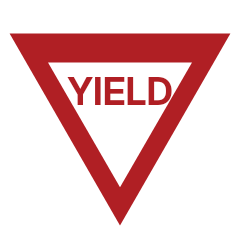
Show answer
Answer D: Slowing to a speed that allows stopping, then going on without stopping if the way stays clear
This control asks the driver to slow down and be ready to stop, and a full stop becomes necessary only when traffic or pedestrians would otherwise be interfered with.