
Kansas DOV Permit Practice Test 40
- Questions25
- Correct to pass20
- Passing score80%
- Minimum age14 years
-
1. The electric windows will not work as your vehicle sinks in water. What is the best option?
Show answer
Answer C: Break a side window with a hard, pointed object and climb out through it
Side windows are tempered glass and can be broken, while the laminated windshield cannot, and water pressure holds the doors shut.
-
2. You are turning right where a paved trail crosses the road just past the corner. What should you look for?
Show answer
Answer B: Cyclists and walkers arriving from either direction on the trail
A shared use path carries two-way traffic on foot and on bicycles, so scan both directions along the trail before crossing it.
-
3. You are stopped at a stop sign where your road ends at a two-way through street and you plan to turn left. What must you yield to?
Show answer
Answer B: Traffic from both directions and any pedestrians crossing
A left turn from the stem of a T crosses the near lane and joins the far one, so you give way to traffic in both directions and to pedestrians.
-
4. You have finished parallel parking at the curb. How should the vehicle sit?
Show answer
Answer A: Close to the curb, so that it does not stick out into the traffic lane
A parked vehicle must sit close enough to the curb that it does not intrude into the path of passing traffic; the exact maximum distance is set by each state.
-
5. On a Kansas highway with two or more lanes in your direction, what must you do when approaching a stationary emergency vehicle using visual signals?
Show answer
Answer D: Proceed with due caution and, if possible and safe, change into a lane that is not adjacent to it
K.S.A. 8-1530 requires a driver on a multilane highway to proceed with due caution and, when possible and safe, change into a lane not adjacent to the stationary emergency vehicle, or otherwise slow to a safe speed.
-
6. The light turns yellow when your front wheels are already past the stop line inside the intersection. What should you do?
Show answer
Answer B: Keep going and clear the intersection without speeding up
Once you are legally in the intersection the safest and correct action is to continue through and clear it, without accelerating.
-
7. Your light turns green, but a vehicle is still in the middle of the intersection. What should you do?
Show answer
Answer D: Wait until the intersection is clear before you move ahead
A green light means go only when the way is clear. Drivers already inside the intersection must be allowed to finish crossing.
-
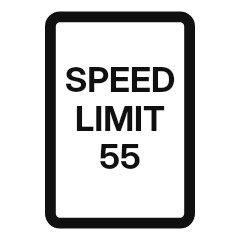
8. Heavy rain has left standing water on the road where this sign is posted. What does the law expect of the driver?
Show answer
Answer C: Driving below the posted figure, at a speed that suits the conditions
Drivers must adapt to conditions, so in rain, fog, snow or dense traffic the safe speed falls below the posted maximum and keeping to that maximum can itself be an offense.
-
9. For how long does the Kansas Division of Vehicles revoke the driving privileges of a habitual violator?
Show answer
Answer D: Three years
K.S.A. 8-286 directs the division to revoke a habitual violator's driving privileges for a period of three years.
-
10. A flagger turns the paddle to the orange face reading SLOW. What does that tell approaching drivers?
Show answer
Answer D: Reduce speed and continue through the work area with care
The SLOW face keeps traffic moving at a reduced speed while workers or equipment are close to the travel lanes.
-
11. You are backing out of a driveway that crosses a public sidewalk. What should you do?
Show answer
Answer C: Stop before the sidewalk and check both ways
Walkers, runners and riders use the sidewalk at speeds that can bring them into your path in a second, so the stop and the look belong before the sidewalk, not after it.
-
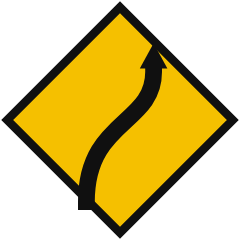
12. A driver holds a steady highway speed into the section this sign warns about. What is the most likely result?
Show answer
Answer B: The vehicle runs wide toward the outside and can cross into another lane or leave the pavement
Holding speed into a change of alignment asks the tires for more side grip than they can supply, so the vehicle runs wide and the driver is left with less room to correct.
-
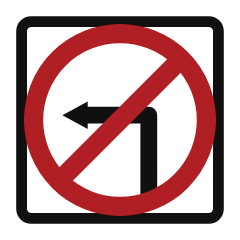
13. A driver in the leftmost lane reaches this sign at an intersection. What must the driver do?
Show answer
Answer B: Go straight on or turn right, and reach the destination another way
The restriction holds whatever the traffic or the signal is doing, so the driver has to pass the intersection and plan a different route.
-
14. You are in the acceleration lane and the gap you were aiming for is now beside you. What is the best adjustment?
Show answer
Answer A: Change your speed a little to line up with a gap, then merge smoothly
The acceleration lane is for matching both the speed and the position of a gap, and small speed adjustments are what line the two up.
-
15. How many motor vehicles must be registered in a person's name in Kansas before that person may seek a certificate of self-insurance?
Show answer
Answer B: More than 25
K.S.A. 40-3104 lets a person in whose name more than 25 motor vehicles are registered in Kansas qualify as a self-insurer through the commissioner of insurance.
-
16. The curb ahead is signed as a bus stop. May you wait there with your vehicle?
Show answer
Answer C: No, the space must stay clear for buses
A bus stop must stay open so that a bus can reach the curb and let passengers on and off safely, so no other vehicle may occupy it.
-
17. A crash happens directly in front of you and vehicles are blocking both lanes. What should you do?
Show answer
Answer B: Stop at a safe distance, put on the hazards and warn the traffic behind
The greatest danger after a crash is a second collision, so stop short of it and make sure the traffic behind you can see the problem.
-
18. How does braking distance change if you double your speed?
Show answer
Answer D: It grows much more than twice as long
Braking distance increases with the square of speed, so doubling speed roughly quadruples the distance needed to stop.
-
19. What do the numbers on a pedestrian countdown display show?
Show answer
Answer A: The seconds remaining to finish a crossing already under way
The countdown runs during the pedestrian change interval and shows how many seconds are left before the crossing time ends.
-
20. You reach an intersection showing a steady red light, and a stop line is painted across your lane. Where must you bring the vehicle to a complete stop?
Show answer
Answer C: Before the stop line
A steady red requires a complete stop before the marked stop line. Where there is no stop line you stop before the crosswalk, and where there is neither, before entering the intersection.
-
21. You leave your car so that its rear overhangs a marked crosswalk. What is wrong with that?
Show answer
Answer B: Pedestrians must step around it into the traffic lane
A crosswalk has to stay completely clear; anything sticking into it pushes people on foot out into the path of moving vehicles.
-
22. Is it acceptable to drive with your vehicle straddling the line between two lanes?
Show answer
Answer D: No, you must drive as nearly as practical entirely within a single lane
A vehicle astride the line takes up two lanes and leaves the drivers around it unable to predict where it will go.
-
23. You are leaving a freeway at an exit that has a deceleration lane. Where should you slow down?
Show answer
Answer C: After you have moved fully into the exit lane
Braking in a through lane surprises the traffic behind you, so you move into the exit lane at highway speed and then slow down inside it.
-
24. Driving at night you notice that the raised markers along the line beside you are throwing back red light. What does that tell you?
Show answer
Answer C: You are facing traffic and must get off that roadway
Red retroreflection is shown only toward traffic that should not be there, so a red return means the vehicle is heading the wrong way.
-
25. On an unlit road, about how far ahead do high beams normally let you see?
Show answer
Answer D: About 350 to 500 feet ahead of the vehicle
High beams light roughly 350 to 500 feet of road and low beams far less, which is why night speeds have to be chosen around the beam, not the limit.