
Kansas DOV Motorcycle Practice Test 54
- Questions25
- Correct to pass20
- Passing score80%
- Minimum age14 years
-
1. Why does full riding gear matter on a short trip around the neighborhood?
Show answer
Answer D: Pavement takes skin off at 25 miles an hour just as it does at 55
Serious injuries happen at ordinary street speeds and close to home, so gear that is worth wearing on a long trip is worth wearing on a short one.
-
2. Why must a tank bag be strapped down properly rather than simply laid on the tank?
Show answer
Answer D: Because a bag that slides can reach the controls or your hands
Braking pushes anything loose on the tank forward toward the handlebars, where it can jam the steering or interfere with the levers.
-
3. Why is parking next to a fire hydrant or in a marked fire lane prohibited?
Show answer
Answer D: It would delay firefighters who need immediate access to the hydrant or the building
Fire hydrants and fire lanes must remain clear at all times so emergency crews can connect hoses and reach a building without delay.
-
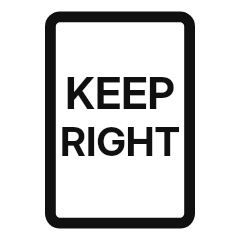
4. A driver ignores this sign and passes on the opposite side. What is the main risk?
Show answer
Answer B: Ending up on the wrong side of a divider, facing traffic coming the other way
The sign settles which side of a fixed divider is the legal one, so taking the other side sends the vehicle into the opposing stream or straight at the obstruction.
-
5. A sign reads REDUCED SPEED LIMIT AHEAD. What does it tell you?
Show answer
Answer D: A lower limit begins further along the road
The sign gives advance notice so a driver can slow gradually, and the new figure takes effect at the speed limit sign that follows.
-
6. Some crosswalks are marked with two transverse lines and others with a row of wide bars laid along the direction of travel. Why is the second pattern used?
Show answer
Answer B: It is far easier for an approaching driver to see
Longitudinal bar patterns are used where extra visibility is wanted, such as an uncontrolled crossing or one near a school, because they show up much better from a car.
-
7. You have just had bad news and you feel very upset. What should you do?
Show answer
Answer B: Wait until you have calmed down, or else let somebody else drive
Strong emotion takes attention away from the road as surely as alcohol or fatigue, so it is a reason not to drive yet.
-
8. A driver is following your motorcycle much too closely. What should you do?
Show answer
Answer B: Ease off the throttle and open more space ahead so the driver can pass
Slowing gradually and opening a bigger gap in front encourages the tailgater to pass and gives the rider room to stop gently instead of hard.
-
9. You are traveling in the same direction as a funeral procession and want to get ahead of it. What should you not do?
Show answer
Answer B: Driving in between the vehicles of the procession
Most states prohibit driving into or through a funeral procession, and cutting into the line leaves the drivers behind with no lead vehicle to follow, so go around only where passing is permitted.
-
10. The street you are turning right onto has a bike lane along its right edge. Where should your vehicle end up?
Show answer
Answer B: In the first traffic lane to the left of the bike lane
A bike lane is not a travel lane for motor vehicles, so the nearest lane you may finish a right turn in is the first general traffic lane beside it.
-
11. A yellow diamond shows a car with wavy lines behind its rear tires. What is the warning?
Show answer
Answer D: The surface loses grip badly when it is wet
The slippery when wet sign marks a stretch where traction falls off sharply in rain, so speed and braking must be reduced well in advance.
-
12. What is the role of the sweep rider in a group?
Show answer
Answer B: To ride last, watch the group, and notice when a rider drops back or has trouble
The sweep rider takes the last position so that any rider who slows, stops or has a problem is noticed instead of being left behind.
-
13. Which statement about standard drinks is correct?
Show answer
Answer C: A standard serving of beer, of table wine and of distilled spirits each contain about the same amount of pure alcohol
Roughly 12 ounces of regular beer, 5 ounces of table wine and 1.5 ounces of 80 proof spirits each contain about the same amount of pure alcohol, so the type of drink does not change the effect.
-
14. You are about to pull out from a stop sign. Which scanning habit is correct?
Show answer
Answer A: Look to the left, then to the right, then to the left again before moving
Traffic from the left reaches you first, and a second look left catches anything that arrived while you were looking right.
-
15. Why is the staggered formation abandoned in a curve?
Show answer
Answer D: Because each rider needs the full width of the lane to choose a line through the curve
In a curve every rider must be free to use the whole lane to set up an entry and an exit line, which is impossible while holding a fixed side position.
-
16. How long is the ignition interlock restriction after a Kansas driver serves the suspension for a first test failure with nothing else on the record?
Show answer
Answer C: 180 days
K.S.A. 8-1015 restricts the driver to an interlock equipped vehicle for 180 days after the 30 day suspension, unless the record shows one of the listed prior convictions.
-
17. What happens when alcohol is combined with another drug that also affects the nervous system?
Show answer
Answer B: Impairment is often far greater than either one alone would produce
Combined substances can multiply each other's effects, producing impairment well beyond what a driver would expect from either one taken separately.
-
18. You approach a traffic signal that has already been green since it first came into view. What should you expect?
Show answer
Answer B: That it may change at any moment, so be ready to stop
A signal already green when you first see it is well into its cycle, so a rider covers the brakes and plans a stop rather than assuming a clear run.
-
19. How does higher speed affect the outcome of a crash?
Show answer
Answer A: It leaves less time to react and greatly increases the force of impact
Speed shortens the time available to avoid a hazard and raises the energy released in an impact, so both the likelihood and the severity of a crash increase.
-
20. Visibility drops suddenly and you decide to leave the highway. What is the safest way to do it?
Show answer
Answer A: Take the next exit or a wide pull off, well clear of the traffic lanes
Get right off the traveled way, and off the shoulder too if you can, because vehicles in poor visibility often drift onto the shoulder.
-
21. How should you position your vehicle for a right turn from a two-way street?
Show answer
Answer B: As close as practical to the right curb or edge, then turn into the nearest right lane
Right turns are made from the lane nearest the right edge into the nearest available lane, which keeps the turn tight and prevents a wide sweep into other traffic.
-
22. What happens on a first occurrence when a Kansas driver under 21 tests at 0.02 or greater but less than 0.08?
Show answer
Answer A: A 30 day suspension of driving privileges
K.S.A. 8-1567a makes it unlawful for a person under 21 to operate with a breath or blood alcohol content of 0.02 or greater, and provides a 30 day suspension on a first occurrence and one year on a second or subsequent occurrence.
-
23. You have a green light and are turning right while people are crossing the street you want to enter. Who goes first?
Show answer
Answer B: The pedestrians, and you wait until they are clear of your path
A green light permits the turn but does not remove the duty to yield to pedestrians already crossing the street you are turning into.
-
24. A person in a wheelchair is traveling in the roadway because the sidewalk is blocked by construction. What should you do?
Show answer
Answer B: Pass slowly with plenty of room, or wait
A blocked sidewalk leaves the person no choice but the road, and a chair cannot move aside quickly, so pass wide and slow or wait for room.
-
25. Which devices does the Kansas definition of a wireless communication device deliberately leave out?
Show answer
Answer A: Voice-operated devices that let a user send or read text without either hand
K.S.A. 8-15,111 excludes a voice-operated device that lets the user send or receive a text based communication without using either hand, except to switch a feature on or off.