
Kansas DOV Motorcycle Practice Test 4
- Questions25
- Correct to pass20
- Passing score80%
- Minimum age14 years
-
1. The posted limit is 55 mph, but heavy traffic and rain make that speed unsafe. What does the law expect of you?
Show answer
Answer D: You must slow to a speed that is safe for the conditions
The basic speed rule requires a speed that is reasonable for the traffic, weather and road, and that speed is often well below the posted maximum.
-
2. A SHOULDER DROP OFF sign warns that
Show answer
Answer B: there is a step down from the pavement to the shoulder
The sign is used where the edge of the pavement stands several inches above the shoulder, which can grab a wheel and pull the vehicle sideways.
-
3. Warning signs such as stop ahead, yield ahead and signal ahead are installed mainly where
Show answer
Answer B: the traffic control device cannot be seen from far enough away
These advance warning signs are used when a crest, curve or obstruction keeps the stop sign, yield sign or signal from coming into view in time for a driver to react.
-
4. When may a Kansas driver type a text message without breaking the written communication ban?
Show answer
Answer C: When the vehicle is stopped off the regular traveled portion of the roadway
K.S.A. 8-15,111 exempts a motor vehicle stopped off the regular traveled portion of the roadway.
-
5. Two lanes at the corner are marked for right turns. What does that require of you?
Show answer
Answer A: Keep your own lane through the turn and into the matching new lane
Dual turn lanes work only if each vehicle stays in its own lane all the way round and finishes in the corresponding lane of the new street.
-
6. What is the purpose of carrying a first aid kit in your vehicle?
Show answer
Answer D: It lets you treat cuts and bleeding while the help is on its way
A kit is for simple first aid such as controlling bleeding until trained help arrives, not a substitute for calling for that help.
-
7. A rider signals that they need to stop, although nobody else in the group wants a break. What should happen?
Show answer
Answer A: The group stops, because a rider who needs a break should get one
A rider who is tired, cold or uncomfortable is a hazard to the whole group, and stopping costs far less than the mistake that follows.
-
8. Where should a rider in the middle of a group direct their attention?
Show answer
Answer A: Well ahead through the group and around it, not just at the rider in front
Watching only the machine ahead hides the traffic and hazards further up the road, and it leaves the rider reacting late to everything the group meets.
-
9. How much space should you hold behind the rider who is directly ahead of you in your own portion of the lane?
Show answer
Answer D: At least two seconds
Riders sharing the same track keep a following distance of at least two seconds so they have the time and the room to react to a hazard.
-
10. You reach a stop-controlled intersection at the same time as a driver on your left, but that driver is already moving through the crossing. Who goes first?
Show answer
Answer C: The driver who is already inside the intersection
A vehicle already in the intersection has the right of way, and the rule about yielding to the right applies only before anyone has entered.
-
11. You are entering a marked school zone during the posted hours. What should you do?
Show answer
Answer A: Slow to the school zone limit and watch for children
The school zone limit applies throughout the posted hours, whether or not you can see any children at that moment.
-
12. You are stopped at a red light waiting to turn right where the turn is allowed. Besides traffic from the left, what must you check?
Show answer
Answer D: Both crosswalks, and anyone approaching along your right side
A right turn on red crosses the crosswalk in front of you and enters the one on the cross street, and cyclists often approach along your right.
-
13. How should a group decide how often to stop for fuel?
Show answer
Answer A: By the range of the machine with the smallest fuel tank
Planning around the smallest tank keeps the group from splitting up when one rider has to leave the route to look for fuel.
-
14. A small plate under a stop sign reads CROSS TRAFFIC DOES NOT STOP. What is it telling you?
Show answer
Answer D: Traffic on the cross street is not required to stop at all
The plate warns that the other road is uncontrolled, so you must wait for a gap instead of expecting anyone to take turns with you.
-
15. How long can cannabis affect a driver?
Show answer
Answer A: For hours after the strongest effects have passed
Slowed reactions, poor tracking and weak judgment of distance can last for hours, well beyond the point where the user believes the effects are over.
-
16. You are passing a crash on the other side of a divided highway. What should you do?
Show answer
Answer D: Keep your eyes on your own lane and the traffic around you
Staring at a crash scene, often called rubbernecking, causes sudden slowing and secondary collisions. Your attention belongs on the traffic in front of you.
-
17. In a staggered formation, where does the second rider belong?
Show answer
Answer C: In the right portion of the lane, about one second behind the leader
The second rider uses the opposite side of the lane roughly one second behind the leader, which staggers the group without stretching it out or putting the two riders alongside each other.
-
18. Where does the restriction that starts at this sign come to an end?
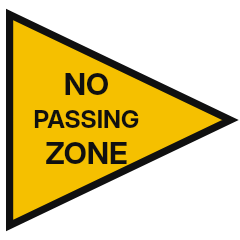
Show answer
Answer D: Where the centerline markings show that overtaking is allowed again
The sign marks the start of the restricted section, and the centerline markings along the road show how far it runs and where overtaking becomes lawful again.
-
19. Where should a rider with a disabled motorcycle try to stop?
Show answer
Answer D: Well clear of the traffic lanes, off the shoulder where there is room
Getting completely away from moving traffic protects the stopped rider and anyone helping, and a shoulder alone is not a safe place to work on a machine.
-
20. Why is the front brake avoided during a very slow, tightly leaned turn?
Show answer
Answer D: It can upset the balance of a leaned machine and drop it at low speed
At low speed and full lock there is little momentum holding the motorcycle up, and the sudden weight shift from the front brake easily topples it.
-
21. A flagger in a work zone turns a paddle so that the red octagonal face reading STOP is toward you. What must you do?
Show answer
Answer A: Stop completely and wait for the flagger to signal you forward
The STOP face of a flagger paddle requires a complete stop, and you may move again only when the flagger directs you to.
-
22. You are in a minor collision on a busy road. No one is hurt and both vehicles can be driven. What is the recommended thing to do?
Show answer
Answer C: Move the vehicles out of the travel lanes to a safe spot before exchanging information
Vehicles left in traffic after a minor crash invite a second, often worse, collision. Clearing the lane protects everyone, and you still exchange details and report as required.
-
23. You have just been involved in a crash on a city street. Which sequence of first steps is correct?
Show answer
Answer A: Stop where you are, check everyone for injuries, and then make the scene safe
You are required to stop, and the first priority at the scene is people, followed by preventing a second collision.
-
24. Where is a U-turn generally the most reasonable choice?
Show answer
Answer B: At an intersection where it is permitted and you can see well both ways
A U-turn needs a legal place and a long clear view in both directions, which is why a permitted intersection with open sight lines is the usual choice.
-
25. You approach a one-lane bridge and there is a yield sign facing your side of it. What does that mean?
Show answer
Answer B: Oncoming traffic crosses the bridge first and you wait at the approach
At a one-lane bridge the yield sign tells one direction to give way, so you wait clear of the bridge until oncoming traffic has crossed.