
Kansas DOV Motorcycle Practice Test 36
- Questions25
- Correct to pass20
- Passing score80%
- Minimum age14 years
-
1. You are fitting a tank bag to your motorcycle. What must you check?
Show answer
Answer B: That it does not foul the handlebars or block your view of the instruments
A bag that catches the bars at full lock or hides the instruments interferes with control of the motorcycle exactly where the rider needs it most.
-
2. A yellow diamond shows an arrow bent into a series of reversing turns. What does it warn about?
Show answer
Answer A: Three or more changes of direction close together
The winding road sign replaces a string of separate curve signs where several bends follow one another with only short straights between them.
-
3. Someone stops drinking heavily at two in the morning and drives to work at eight. What is true?
Show answer
Answer A: They may still be impaired and over the limit
The body removes alcohol at a slow, fixed rate, so a heavy night can leave a driver impaired well into the next morning no matter how they feel.
-
4. About how far ahead do low beam headlights let you see on a dark road?
Show answer
Answer B: About 250 feet
Low beams light roughly 250 feet of road, and high beams roughly 350 to 500 feet, which sets the limit on a safe night speed.
-
5. An overhead lane signal shows a flashing yellow X above your lane. What does it mean?
Show answer
Answer D: The lane may be used only for a left turn
A flashing yellow X marks a lane that may be used only to make a left turn; a steady yellow X is the one that warns you to leave the lane.
-
6. If the rear wheel locks during a straight line stop on a good surface, the rider should:
Show answer
Answer B: Keep it locked until the motorcycle has come to a complete stop
Releasing a locked rear wheel while the motorcycle is out of line can snap it upright violently, so on a straight path the rear brake is held until the motorcycle stops.
-
7. After turning right you see a sign showing that your lane ends a short way ahead. What should you do?
Show answer
Answer B: Signal and merge into the next lane while there is still room
Merge early and smoothly while a gap is still available, rather than running out of pavement or forcing your way in at the last moment.
-
8. A minor drop has left the clutch lever bent, although it still works. What should be done?
Show answer
Answer B: Have the lever replaced before the motorcycle is ridden again
A bent lever has already been weakened and can break off in use, leaving the rider without that control at the worst possible moment.
-
9. A yellow horizontal rectangular sign showing one large arrow pointing left or right, facing traffic on the far side of a sharp bend, tells the driver
Show answer
Answer C: which way the roadway turns at that point
The large arrow sign is mounted on the outside of a sharp change in alignment so that a driver approaching head on immediately sees which way the road goes.
-
10. A NO LEFT TURN sign carries a plaque reading 7 AM TO 9 AM MON TO FRI. What does the assembly mean?
Show answer
Answer A: The turn is banned only during those hours on those days
A time plaque limits the restriction to the periods shown, so outside those hours and days the left turn may be made normally.
-
11. The group has become separated and the leader wants to wait for the missing riders. Where should the leader pull in?
Show answer
Answer C: In a parking area or other space that is clear of moving traffic
Waiting somewhere off the roadway keeps the parked machines and their riders out of traffic and gives the arriving riders room to pull in safely.
-
12. You are stopped at a red light ready to turn right when a person pushing a stroller steps into the crosswalk. What should you do?
Show answer
Answer A: Stay stopped until they have crossed your path
A turn on red gives way to every pedestrian in the crosswalk, and someone pushing a stroller has even less room to react.
-
13. What is the most effective way for a rider to be seen by other drivers?
Show answer
Answer C: Wear brightly colored reflective gear, or a reflective vest over dark clothing
The most common thing drivers say after a collision with a motorcycle is that they never saw it, and bright reflective gear on the helmet and torso is the largest visible surface the rider controls.
-
14. The engine has warmed up and idles smoothly. What should be done with the choke?
Show answer
Answer C: Turn it off
A warm engine running on a rich mixture wastes fuel, runs poorly and can foul the spark plugs, so the choke is closed once it is no longer needed.
-
15. What is the right speed for a normal right turn at a city corner?
Show answer
Answer C: Slow enough to hold your lane and stop for a pedestrian
A city right turn is tight and crosses a crosswalk, so the correct speed is one that keeps you inside your lane and still allows a stop.
-
16. What must you do before changing lanes, in addition to signaling and checking your mirrors?
Show answer
Answer D: Glance over your shoulder to check the blind spot the mirrors do not cover
Mirrors leave an area beside and behind the vehicle that they cannot show, so a quick head check is needed before the vehicle moves sideways.
-
17. When is a driver at the highest risk of falling asleep at the wheel?
Show answer
Answer B: Late at night, early morning and mid afternoon
The body clock produces its deepest dips in alertness in the small hours and again in the middle of the afternoon, and crash records follow those dips.
-
18. You are driving on a two-lane road approaching the crest of a hill. Where should you position your vehicle?
Show answer
Answer D: Toward the right side of your lane, in case an oncoming vehicle is over the center line
You cannot see what is beyond a crest, and oncoming drivers sometimes drift across the center. Keeping right and slowing gives you a margin.
-
19. What should you confirm about your saddlebags before riding away?
Show answer
Answer A: That both are latched shut and neither is overloaded
An unlatched or overstuffed bag can swing open or sag into the rear wheel or the exhaust, either of which can wreck the machine's handling at once.
-
20. What do flashing yellow lights on a school bus mean?
Show answer
Answer A: The bus is about to stop to load or unload, so prepare to stop
The amber lights are the warning phase that comes before the red lights and the stop arm, so drivers should slow down and get ready to stop.
-
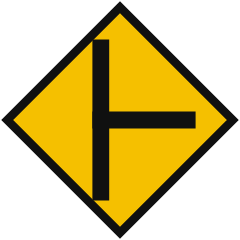
21. What condition does this sign warn a driver about?
Show answer
Answer B: Another road joins the road being traveled, from one side
It announces a side road entering the main roadway, so the driver should expect vehicles waiting to pull out and other vehicles slowing to turn in.
-
22. The left-turn signal facing you shows a flashing yellow arrow. What does it mean?
Show answer
Answer C: You may turn left after yielding to oncoming traffic and to pedestrians
A flashing yellow arrow permits a left turn but gives no protection, so you must yield to oncoming vehicles and to people in the crosswalk.
-
23. While you swerve around an obstacle, what should the rest of your body be doing?
Show answer
Answer C: Staying upright with the knees against the tank while the motorcycle leans
A swerve happens through the handlebars, and a body that stays still and anchored to the tank lets the motorcycle move quickly beneath the rider.
-
24. At an intersection where every approach carries this sign, two drivers arrive at exactly the same instant. Which of them goes first?

Show answer
Answer C: The driver on the right
Order of arrival decides who goes first, and when two vehicles arrive together the driver on the right proceeds while the other gives way.
-
25. For the first six months after turning 16, when may a Kansas restricted licensee drive without one of the listed exceptions?
Show answer
Answer B: Only from 5 a.m. to 9 p.m.
K.S.A. 8-2,101 limits a 16 year old restricted licensee to driving from 5 a.m. to 9 p.m. for six months, apart from trips connected with work, school activities, religious activities, or driving accompanied by a qualifying adult.