
Kansas DOV Motorcycle Practice Test 31
- Questions25
- Correct to pass20
- Passing score80%
- Minimum age14 years
-
1. On a street with parking along the curb, the shared lane marking is painted well out from the curb face. What does that placement tell a bicyclist?
Show answer
Answer C: To ride clear of the doors of parked cars
The marking is set at least eleven feet from the curb where parking is allowed so that riders are guided outside the reach of an opening door.
-
2. What has to be done with the helmet chin strap on every ride?
Show answer
Answer B: Fastened snugly, because an unfastened helmet comes off in a crash
A helmet only protects while it stays on the head, and an unfastened or loose strap lets it leave the head in the first moments of a crash.
-
3. What actually lowers the amount of alcohol in a person's blood?
Show answer
Answer D: The passage of time
The body eliminates alcohol at its own steady rate, so only time reduces blood alcohol. Coffee or a cold shower may make a person feel more awake while still impaired.
-
4. How closely may a Kansas driver follow fire apparatus that is answering a fire alarm?
Show answer
Answer C: No closer than 500 feet
K.S.A. 8-1581 bars a driver not on official business from following fire apparatus responding to an alarm closer than 500 feet, or stopping within 500 feet of apparatus halted at an alarm.
-
5. A deer crosses the road in front of you and disappears into the trees. What should you expect?
Show answer
Answer B: That other deer are likely to follow it across the very same stretch of road
Deer usually move in groups, so one crossing the road is a warning that more may follow.
-
6. You are in the middle of an intersection when you hear a siren and see an emergency vehicle approaching. What should you do?
Show answer
Answer A: Keep going, clear the intersection, then pull to the right and stop
Stopping inside an intersection blocks the emergency vehicle. Clear the intersection first, then pull over to the right and stop.
-
7. You feel fine twenty minutes after your last drink. Why is that a poor guide to driving?
Show answer
Answer B: Your blood alcohol level can still be rising
Alcohol keeps being absorbed for some time after the last drink, so a driver who feels able at the door can be more impaired a few miles down the road.
-
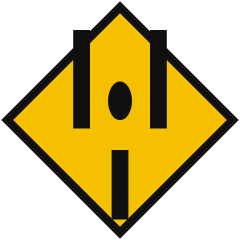
8. Beyond the point this sign refers to, which movement becomes unlawful?
Show answer
Answer D: Driving on the far side of the separation, against the flow
Once the two directions are separated, each roadway carries one-way traffic, so crossing to the other side means driving into oncoming vehicles.
-
9. A signal stands part way up a freeway entrance ramp and turns green briefly again and again. How many vehicles does such a signal normally release on each green?
Show answer
Answer A: One for each lane of the ramp
A ramp control signal releases a single vehicle per lane on each green so that vehicles reach the merge one at a time instead of in a bunch.
-
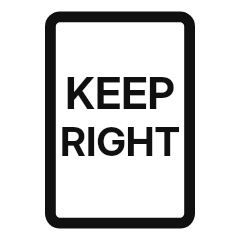
10. Where is this sign normally installed?
Show answer
Answer A: At an island or other obstruction in the roadway, to show which side traffic must take
It is placed at a divider, island or fixed obstruction so that drivers approaching it know without hesitating which side to pass on.
-
11. You are driving on a divided highway and see a solid yellow line along the left side of your lanes. What does it tell you?
Show answer
Answer D: It marks the left edge of the roadway for your direction
On a divided highway or a one-way roadway, the left edge of the traveled way is marked with a solid yellow line.
-
12. What should a passenger do when the motorcycle leans into a curve?
Show answer
Answer A: Lean with the operator, staying directly behind them
A passenger who leans with the operator lets the motorcycle follow its natural line, while leaning against the lean fights the operator's control inputs.
-
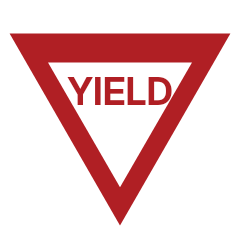
13. A driver passes this sign on an entrance ramp while merging onto a freeway. Who has priority?
Show answer
Answer B: The traffic already traveling on the freeway
The sign places the duty on the entering driver, who must adjust speed and fit into a gap without forcing through traffic to brake or swerve.
-
14. What does it mean to scan the road while driving?
Show answer
Answer A: Moving your eyes constantly over the road, the sides and the mirrors
Scanning keeps information coming in from every direction, while a fixed stare leaves you blind to everything else.
-
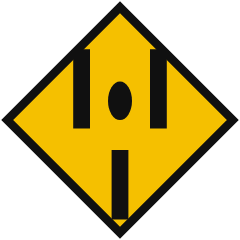
15. What must a driver be ready for beyond this sign?
Show answer
Answer C: Vehicles approaching from the opposite direction in the next lane over
The separation between the two directions runs out, so from that point oncoming vehicles share the same pavement and the driver has to keep right.
-
16. A squirrel darts into your path a short distance ahead. What is normally the safest response?
Show answer
Answer C: Hold your line, brake as much as is safe, and accept hitting a small animal
Swerving without space, or crashing while braking, hurts the rider far more than a small animal does, so stay in your lane and slow as much as traction allows.
-
17. Unless posted otherwise, what is the maximum lawful Kansas speed on highways that are not urban districts, county or township roads, or separated multilane highways?
Show answer
Answer C: 65 miles per hour
K.S.A. 8-1558 sets 65 miles per hour on all other highways once the urban district, county and township, and separated multilane categories are accounted for.
-
18. You park at the roadside on a hill, facing downhill. What keeps the motorcycle from rolling away?
Show answer
Answer D: Leaving it in first gear with the front wheel turned toward the curb
A motorcycle has no parking brake, so the transmission left in gear stops the wheel turning and the front wheel turned into the curb blocks any roll.
-
19. How should your following distance change in heavy rain?
Show answer
Answer D: It should be increased well beyond what you use on dry pavement
Wet pavement lengthens stopping distance and rain cuts visibility at the same time, so a larger gap gives you the extra seconds needed to see a problem and stop for it.
-
20. The throttle sticks open and will not close when you roll it back. What should you do?
Show answer
Answer B: Squeeze in the clutch and shut the engine down with the cut-off switch
Pulling in the clutch cuts power to the rear wheel immediately, and the cut-off switch stops the engine without the rider letting go of the handlebars.
-
21. An oncoming driver flashes their headlights while you are waiting to turn left. What should you do?
Show answer
Answer D: Judge the situation yourself, since the flash may mean something else
A flash is not a legal signal and may mean many things, so the decision to turn stays yours and must be based on what you can see.
-
22. The curb ahead is signed as a bus stop. May you wait there with your vehicle?
Show answer
Answer C: No, the space must stay clear for buses
A bus stop must stay open so that a bus can reach the curb and let passengers on and off safely, so no other vehicle may occupy it.
-
23. A driver waiting to turn left appears to be looking straight at you. What should you assume?
Show answer
Answer C: That the driver may still not have seen you, and may turn across your path
Drivers look toward motorcycles without registering them, so eye contact is not evidence that the rider has been seen and no plan should depend on it.
-
24. Which of these is a known cause of a high speed wobble?
Show answer
Answer C: Incorrect tire pressure or a load carried too far back and too high
Wobble is usually traced to tires, wheels, loading or poorly mounted accessories such as a windshield or fairing, so check pressures and how the machine is loaded.
-
25. A single solid white line separates two lanes running in the same direction. What is it telling drivers?
Show answer
Answer A: Changing lanes there is discouraged
A solid white lane line discourages lane changing, typically where merging or weaving would create a hazard.