
Kansas DOV Motorcycle Practice Test 27
- Questions25
- Correct to pass20
- Passing score80%
- Minimum age14 years
-
1. Should a rider change lanes while passing through an intersection?
Show answer
Answer A: No, the lane change should be completed before or after the intersection
Drivers entering and turning at an intersection are watching lanes rather than a machine moving between them, and lane markings are usually broken there.
-
2. You are driving on a road covered with a layer of wet fallen leaves. What should you expect?
Show answer
Answer B: As little grip as on ice, plus hidden markings and hidden holes
Wet leaves are as slippery as ice and they hide the lane lines and any potholes underneath, so slow well before curves and stops.
-
3. An oncoming vehicle at night has its high beams on and you are being dazzled. Where should you look?
Show answer
Answer A: Toward the right edge of your lane
Looking toward the right edge line keeps you on course while sparing your eyes the worst of the glare. Slow down and do not retaliate with your own high beams.
-
4. A yellow sign reads SOFT SHOULDER. What is it telling you?
Show answer
Answer C: The shoulder may not carry the weight of a vehicle
A soft shoulder is unpaved and can let a wheel sink, so a driver who leaves the pavement there may lose control or become stuck.
-
5. You come up behind a bicyclist who is descending a steep hill in the middle of the traffic lane. What should you take into account?
Show answer
Answer D: The rider may be moving at close to the speed of the traffic
A bicycle can reach the speed of traffic on a descent, so there is little to gain from a pass and the rider needs the whole lane to steer around surface hazards.
-
6. Blue pavement markings are used together with white markings at
Show answer
Answer D: parking spaces reserved for people with disabilities
Blue supplements the white markings of accessible parking spaces, which is the only assignment blue has on the pavement.
-
7. What does Kansas law say about riding a motorcycle between lanes of moving traffic?
Show answer
Answer D: It is forbidden, and no more than two motorcycles may share a single lane
K.S.A. 8-1595 forbids operating a motorcycle between lanes of traffic or between adjacent lines of vehicles, and allows no more than two motorcycles abreast in one lane.
-
8. Which of these is true of the roadway a driver is being sent onto here?
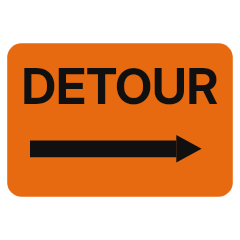
Show answer
Answer D: Its own signs, signals and speed limits govern for the whole way around
The alternate route is an ordinary public road, so every control posted on it governs as usual; being sent that way grants no extra priority and no relief from the limits in force there.
-
9. There is a stop sign but no stop line and no crosswalk. Where must you stop?
Show answer
Answer A: Before entering the intersection, where you can see cross traffic
With no line or crosswalk, stop before you enter the intersection at the point where you can see traffic on the cross street.
-
10. Before pulling out to pass on a two lane road, which lane position gives the best view of the road ahead?
Show answer
Answer B: The left portion of your lane
Moving to the left of your own lane lets you see past the vehicle ahead and judge the oncoming lane before committing any part of the machine to it.
-
11. How does a rider judge whether the brake pads still have life left in them?
Show answer
Answer A: By looking at how much friction material is left on the pad
Pads are inspected visually for remaining thickness against the wear indicator, because a pad worn to its backing plate will destroy the disc.
-
12. Which set of qualities should eye protection for riding have?
Show answer
Answer A: Shatter resistant, free of scratches, and sealed against the wind
Riding eye protection has to survive an impact, let you see clearly and keep the air out, which is why plastic face shields and goggles are used instead of ordinary glasses.
-
13. What is the minimum sentence on a first Kansas conviction for driving under the influence?
Show answer
Answer C: 48 consecutive hours in jail, or 100 hours of public service if the court allows
K.S.A. 8-1567 requires not less than 48 consecutive hours of imprisonment on a first conviction, or 100 hours of public service in the court's discretion.
-
14. You are traveling a long distance on a highway with three lanes in your direction, at about the speed of the surrounding traffic. Which lane is generally the best choice?
Show answer
Answer C: The center lane, which keeps you clear of merging traffic and of overtaking traffic
On a three-lane roadway the center lane avoids both the ramp traffic on the right and the overtaking traffic on the left, so it usually has the steadiest flow.
-
15. What is a driver being warned about here?
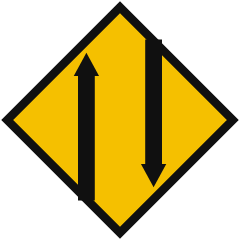
Show answer
Answer B: The pavement ahead carries vehicles traveling in the opposite direction
Beyond this point vehicles come the other way on the same pavement, which commonly happens where a one-way section or a separated stretch comes to an end.
-
16. Who should set the pace of a group ride?
Show answer
Answer A: The last rider in the group, so that nobody is forced to hurry to keep up
The tail ender sets the pace: every rider watches the mirrors for the rider behind, and if someone falls back the whole group slows a little to stay together.
-
17. An orange sign reads RIGHT LANE CLOSED AHEAD. What is the correct response?
Show answer
Answer A: Move left in good time and keep a steady pace
The sign is placed well before the taper so that drivers can merge smoothly rather than braking hard where the lane actually closes.
-
18. What is the best way to keep your phone from distracting you on a trip?
Show answer
Answer D: Silence it and stow it before you start
A phone you cannot hear and cannot reach cannot tempt you, which is far more reliable than deciding case by case while you drive.
-
19. You are turning left from a one-way street onto a two-way street. How should the turn be made?
Show answer
Answer B: Start in the far left lane and finish just to the right of the center line
Left turns begin from the lane nearest the left edge of the street you are leaving and must finish on the right-hand side of the center line of a two-way street.
-
20. You are approaching a multilane roundabout. When should you choose your lane?
Show answer
Answer C: Before you enter, using the lane-choice sign on the approach
You select your lane on the approach the way you would at any multilane intersection, then stay in that lane all the way around, because changing lanes inside a roundabout creates side-impact conflicts.
-
21. What should a pre-ride check of the drive chain or belt look for?
Show answer
Answer C: Correct slack, adequate lubrication and no worn or damaged links
A chain that is too tight, too loose, dry or damaged can break or jump the sprocket and lock the rear wheel while the motorcycle is moving.
-
22. On a wet road, how should a driver adjust after passing this sign?
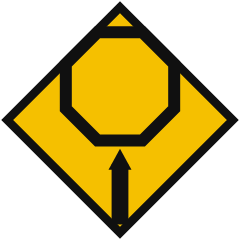
Show answer
Answer B: Start braking earlier, because a slippery surface lengthens the stopping distance
A wet surface lengthens stopping distance, so the extra warning distance should be spent braking gently and early instead of late and hard.
-
23. At a four-way stop another driver pulls out ahead of you when it was clearly your turn. What is the correct response?
Show answer
Answer B: Let that driver go through, then take your turn when the way is clear again
Right of way is something you give, never something you take, so yielding to a driver who takes it wrongly avoids a crash you would otherwise share.
-
24. You are traveling at 55 mph and see a vehicle ahead moving at about 15 mph. What is the hazard?
Show answer
Answer A: You reach it far sooner than you expect
At a 40 mph difference you cover the gap in a few seconds, which is why drivers strike slow vehicles they saw in plenty of time.
-
25. In a normal signal cycle, what comes after a steady red indication?
Show answer
Answer A: A green indication that starts the next movement
Yellow is a warning that a movement is ending, so it never precedes a green; a red is followed by a green or a green arrow.