
Kansas DOV Permit Practice Test 36
- Questions25
- Correct to pass20
- Passing score80%
- Minimum age14 years
-
1. Unless posted otherwise, what is the maximum lawful Kansas speed on highways that are not urban districts, county or township roads, or separated multilane highways?
Show answer
Answer C: 65 miles per hour
K.S.A. 8-1558 sets 65 miles per hour on all other highways once the urban district, county and township, and separated multilane categories are accounted for.
-
2. You are driving on the through road of a T-intersection and want to turn left into the side road. Oncoming traffic is approaching on the through road. What must you do?
Show answer
Answer C: Yield to the oncoming traffic before you turn
The vehicle waiting in the stem of the T yields to both of you, but you still owe the right of way to oncoming through traffic before turning across it.
-
3. A pedestrian is crossing at a corner where no crosswalk is painted on the pavement. What is your duty?
Show answer
Answer A: Yield, because a legal crosswalk exists at the corner even without paint
Every intersection has a crosswalk whether or not it is marked, and drivers must yield to pedestrians crossing there.
-
4. Some drivers believe they can multitask while driving. What does research show?
Show answer
Answer C: The brain switches rapidly between tasks and driving performance suffers
The brain does not truly do two attention-demanding tasks at once; it alternates between them, and the driving task gets less attention each time.
-
5. Your vehicle has a backup camera. What is the right way to use it?
Show answer
Answer C: Use it as an aid, but still turn and look behind you
A camera has a limited field of view and can be dirty or wet, so it supplements looking over your shoulder and using the mirrors rather than replacing them.
-
6. The motorcyclist ahead of you keeps moving from one side of the lane to the other. What should you understand?
Show answer
Answer B: The rider is avoiding surface hazards and staying where drivers can see the bike
Riders shift their lane position to avoid debris, grease strips and potholes and to be seen. That movement is normal and never an invitation to share the lane.
-
7. You are driving through a long curve on a road with two lanes in your direction. What is correct?
Show answer
Answer A: Stay within your own lane all the way through, adjusting speed before you enter
Wandering out of your lane in a curve puts you into the path of a vehicle you cannot see, and the slowing belongs before the curve rather than in it.
-
8. You are about to leave a roundabout when a pedestrian steps into the crosswalk on your exit. What should you do?
Show answer
Answer B: Yield to the pedestrian and wait for the crosswalk to clear
Roundabout crosswalks sit on the entries and exits, and drivers must yield to pedestrians using them.
-
9. How does a lap and shoulder belt protect you in a crash?
Show answer
Answer B: It holds you to the seat and spreads the force over the strong bones
The belt keeps you with the vehicle as it slows and puts the load on the hips and the chest rather than on soft tissue.
-
10. What does a steady yellow traffic light tell the driver facing it?
Show answer
Answer A: The green movement is ending and a red indication is about to appear
A steady yellow warns that the related green movement is being terminated and that red will follow, so you should stop if you can do so safely.
-
11. You are traveling at the same speed as a vehicle in the next lane, just behind its rear door. What should you do?
Show answer
Answer B: Change your speed so that you leave that driver's blind spot
That position is the classic blind spot. Slow slightly or move ahead so the other driver can see you before deciding to change lanes.
-
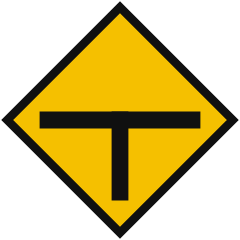
12. What must a driver be prepared to do at the point this sign refers to?
Show answer
Answer D: Turn left or right, because the road being traveled ends there
The road ends at another roadway, so the driver must slow, give way to traffic on the through road and turn in one direction or the other.
-
13. The red brake warning light stays on after you release the parking brake. What should you do?
Show answer
Answer D: Stop safely and have the brakes checked before driving on
With the parking brake released, that light points to low fluid or a fault in one half of the braking system, which can leave you with very little braking.
-
14. Why are drivers required to turn the front wheels when parking on a grade?
Show answer
Answer A: So that a vehicle that starts to roll leaves the traffic lanes instead of entering them
The wheel position is a last line of defense if the parking brake or transmission fails, directing the vehicle into the curb or off the roadway.
-
15. How long does a Kansas driver cited for having no proof of insurance have to produce valid evidence in court and avoid conviction?
Show answer
Answer B: 10 days from the date of arrest or of the citation
K.S.A. 40-3104 bars conviction if the person produces evidence of financial security valid at the time of the citation within 10 days of arrest or citation.
-
16. You are approaching a yield sign and no other vehicle is anywhere in sight. What does the sign require?
Show answer
Answer A: Slow down and be ready to stop, but stop only if needed
A yield sign requires you to slow and give way, and to stop only when traffic or pedestrians make stopping necessary.
-
17. You are behind a snow plow working on a highway. What is the correct way to drive?
Show answer
Answer C: Stay well back and do not try to pass it
A plow throws snow, runs wider than its body and works on the poor surface ahead of it, so the cleared road behind it is the safest place to be.
-
18. You are inside a tunnel with no shoulder when an ambulance comes up behind you with lights and siren. What should you do?
Show answer
Answer D: Keep going at a safe speed and pull over once you are clear of the tunnel
Stopping in a tunnel or on a narrow bridge blocks the only lane, so continue at a safe speed to the first place where you can pull clear.
-
19. You are driving in fog so thick that you can barely see the vehicle ahead. Which pavement marking is the best guide for staying in your lane?
Show answer
Answer A: The white edge line on the right side of the road
The right edge line keeps you positioned away from oncoming traffic and is easy to follow at low speed. Following tail lights closely tempts you to drive faster than you can see.
-
20. What is the purpose of a wide solid white line painted straight across your lane on the approach to an intersection?
Show answer
Answer C: It shows the point where a required stop must be made
A stop line indicates the point at which the stop required by a signal or a stop sign is to be made, ahead of the crosswalk and the intersection.
-
21. A dust storm is blowing across the highway ahead of you. What is the recommended response?
Show answer
Answer B: Leave the road if you can, park well clear and take your foot off the brake
Get well off the pavement, switch the lights off and keep your foot off the brake, so drivers still on the road do not follow your tail lights off the highway.
-
22. You see brake lights several vehicles ahead of you in your lane. What is the best first step?
Show answer
Answer C: Ease off the gas and cover the brake pedal
Reacting to the trouble several vehicles ahead, rather than waiting for the car in front, cuts your reaction time and warns the driver behind you.
-
23. The blue signs mounted before a freeway interchange that carry the logos of individual businesses are
Show answer
Answer C: specific service signs, which show the brands available at that exit
Specific service signs, often called logo signs, list eligible businesses for categories such as gas, food, lodging, camping, attractions and 24-hour pharmacies at the upcoming interchange.
-
24. You have started to pass and you see the no-passing zone beginning ahead. What should you do?
Show answer
Answer D: Ease off, drop back and return to your own lane
A pass must be completed before the no-passing zone starts. If it will not fit, abandon it and slot back in behind.
-
25. A sign with a green background and a white legend normally provides
Show answer
Answer A: directions, distances and destinations
Green is the background color of the guide sign series, which names routes and destinations and gives the distance to them.