
Kansas DOV Permit Practice Test 28
- Questions25
- Correct to pass20
- Passing score80%
- Minimum age14 years
-
1. Your car begins to lose power on a freeway and you must stop. Where should you try to bring it to a halt?
Show answer
Answer A: As far off the right side of the road as you can get, beyond the edge line
A disabled vehicle should be moved completely clear of the travel lanes, on the right, so that traffic can pass without changing course.
-
2. At what alcohol concentration is a Kansas driver aged 21 or older guilty of driving under the influence?
Show answer
Answer C: 0.08 or more
K.S.A. 8-1567 defines driving under the influence to include operating a vehicle when the alcohol concentration in blood or breath is 0.08 or more, including when measured within three hours of operating.
-
3. A driver stopped on suspicion of impaired driving refuses to take a chemical test. What happens?
Show answer
Answer D: A license penalty follows for the refusal itself
Under implied consent, holding a license means agreeing to testing, so a refusal brings its own suspension separately from anything the court decides.
-
4. You are about to descend a long steep grade. How should you control your speed?
Show answer
Answer D: Select a lower gear before starting down and use the brakes in firm, brief applications
Engine braking in a lower gear carries most of the load down the grade, while continuous brake pressure overheats the brakes and reduces their effectiveness.
-
5. A large X with the letters R and R beside it is painted across your lane. What does it mean?
Show answer
Answer A: A railroad crossing lies a short distance ahead
The pavement marking repeats the advance warning for a grade crossing, and it is used on paved approaches where speeds are high or where gates are installed.
-
6. What do yellow lines painted on a roadway separate?
Show answer
Answer D: Traffic moving in opposite directions
Yellow markings separate opposing streams of traffic, and they also mark the left edge of a divided highway or a one-way roadway.
-
7. How should tire pressure be checked and set?
Show answer
Answer B: When the tires are cold, set to the pressure specified by the vehicle manufacturer
Driving heats the air and raises the reading, and the sidewall number is a maximum rather than a recommendation, so check cold and use the figure on the vehicle placard or in the owner's manual.
-
8. After completing a turn you notice your signal is still flashing. What should you do?
Show answer
Answer A: Switch it off at once, before other drivers act on it
A signal left on after a turn is a false message, and drivers waiting to pull out may move into your path because of it.
-
9. You are approaching a horse and rider on a country road. What about your horn?
Show answer
Answer C: Do not sound it at all, because the noise can frighten the animal
A startled horse is dangerous to its rider and to you, so pass wide and slow and leave the horn alone.
-
10. You are driving through patchy fog on a highway. What should you be ready for?
Show answer
Answer B: Sudden dense banks where visibility drops within a few car lengths
Patchy fog can go from clear to nearly blind in a moment, so keep your speed low enough that a sudden bank does not leave you without room.
-
11. At a freeway exit, the paved triangle between the ramp and the through lanes is filled with diagonal white lines. What do they mean?
Show answer
Answer A: Stay out of that area, because it is not meant to be driven on
Chevron and diagonal markings fill paved areas that traffic is not intended to use, so drivers should keep out of them.
-
12. A train has just passed a crossing that carries more than one set of tracks. What should you do?
Show answer
Answer B: Wait until the warning devices stop and you can see clearly along every track
A passing train can hide a second one coming on another track, so wait for the signals to clear and check each track before moving.
-
13. You turn the wheel but the front of the vehicle keeps sliding straight ahead on a slippery road. What should you do?
Show answer
Answer C: Ease off the accelerator and reduce the steering angle until the front tires grip again
A front-wheel skid means the tires are asking for more grip than the surface can give. Less speed and less steering angle let them regain traction.
-
14. In a vehicle with automatic transmission, which foot should operate the brake and accelerator?
Show answer
Answer D: The right foot for both pedals
Using only the right foot prevents pressing both pedals at once and keeps the response the same in every vehicle you drive. The left foot rests on the floor or the footrest.
-
15. What is true about driving away from a crash you were involved in?
Show answer
Answer B: It is a serious offense, even if the other driver has driven away too
Leaving the scene is a criminal offense in every state, and the behavior of the other driver does not excuse it.
-
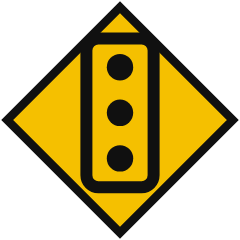
16. What does this sign require of the driver?
Show answer
Answer D: Reducing speed and being ready to stop at the intersection ahead
The advance notice asks the driver to slow and be ready to stop, while whether a stop is actually needed depends on the indication displayed on arrival.
-
17. Why should you avoid swinging wide to the left before making a right turn in a car?
Show answer
Answer A: Another driver may think you are turning left and try to pass on your right
Swinging left first misleads other road users about your intention and invites someone to move up on your right, exactly where you are about to go.
-
18. How should the outside mirrors be aimed to reduce your blind spots?
Show answer
Answer A: Outward, so each one covers the lane beside you rather than repeating the inside mirror
Mirrors aimed too far inward show you the same road three times and leave a large gap beside the vehicle, so aiming them outward shrinks the blind spot.
-
19. A large panel mounted on a trailer at the roadside displays a flashing arrow pointing left. What does it tell you?
Show answer
Answer B: Move into the lane to your left
An arrow panel directs traffic out of a closed lane, so the arrow shows the direction you must move rather than the shape of the road ahead.
-
20. You are waiting to turn left across two oncoming lanes when a driver in the near lane stops and waves you through. What should you do?
Show answer
Answer D: Turn only after checking the far lane yourself
The waving driver cannot give away the right of way of the traffic in the second lane, which may not be stopping at all.
-
21. Why are sign shapes and colors standardized across the whole country?
Show answer
Answer D: So a driver knows the kind of message before reading it
Uniform shapes and colors let a driver classify a sign as regulatory, warning or guide from a distance, before the legend can be read.
-
22. Traffic is backed up just past the exit you want to use at a single-lane roundabout. What should you do?
Show answer
Answer D: Wait at the yield line until you can pass through and exit
You must not enter a roundabout unless you can clear it, because stopping inside blocks every other entry.
-
23. A front tire blows out at highway speed. What should you do?
Show answer
Answer B: Hold the wheel firmly, ease off the accelerator and slow gradually before leaving the road
A blowout pulls the vehicle toward the failed tire, and hard braking or sharp steering can turn that pull into a spin, so a firm grip and gradual slowing keep the vehicle straight.
-
24. Why is a U-turn on a one-way street a problem?
Show answer
Answer A: You would end up facing the wrong way against all the traffic
Every lane of a one-way street runs the same way, so turning around leaves you driving head-on against all of the traffic.
-
25. You stop behind another vehicle at a traffic light. How much space should you leave?
Show answer
Answer D: Enough to see where its rear tires touch the pavement
Seeing the rear tires on the road leaves room to steer around the vehicle if it stalls, and gives a cushion if you are struck from behind.