
Kansas DOV Permit Practice Test 26
- Questions25
- Correct to pass20
- Passing score80%
- Minimum age14 years
-
1. A flagger in a work zone turns a paddle so that the red octagonal face reading STOP is toward you. What must you do?
Show answer
Answer A: Stop completely and wait for the flagger to signal you forward
The STOP face of a flagger paddle requires a complete stop, and you may move again only when the flagger directs you to.
-
2. After turning right you see a sign showing that your lane ends a short way ahead. What should you do?
Show answer
Answer B: Signal and merge into the next lane while there is still room
Merge early and smoothly while a gap is still available, rather than running out of pavement or forcing your way in at the last moment.
-
3. An ambulance with lights and siren is coming toward you on an undivided two-lane road. What must you do?
Show answer
Answer A: Pull to the right edge and stop until it passes
On an undivided road, drivers in both directions clear the way, pulling to the right edge and stopping.
-
4. Why is hard braking the wrong response to a tire blowout at speed?
Show answer
Answer C: Because it can pull the vehicle further out of line and start it spinning
With one tire gone the braking forces are uneven, so heavy braking increases the pull to one side and can spin the vehicle.
-
5. You have stopped on the shoulder of a highway and want to rejoin the traffic. What is the correct way?
Show answer
Answer D: Signal, build up speed along the shoulder, then merge into a gap
Entering a fast lane at a slow speed is what causes the conflict, so the shoulder is used to gain speed before the merge in the same way as an acceleration lane.
-
6. You are stopped at a stop sign on a two-way stop intersection and the cross street has no stop signs at all. What does that mean for you?
Show answer
Answer A: You yield to all cross traffic no matter how long that takes
At a two-way stop only your direction is controlled, so there is no taking turns; you wait for a gap big enough to enter safely.
-
7. You are in a marked passing zone but a steady stream of oncoming traffic is coming toward you. What does the broken center line allow?
Show answer
Answer C: A pass only when the road is clear, so you have to stay behind
A passing zone marks where the sight distance is adequate, but it never gives permission to enter a lane that another vehicle is occupying.
-
8. At an intersection that uses a lagging left turn, when is the left-turn arrow displayed?
Show answer
Answer B: After the through movement has run
A lagging left turn phase runs at the end of the green rather than the start, so a driver waiting to turn should not assume the arrow has been missed.
-
9. Where is a three-point turn most clearly a bad idea?
Show answer
Answer A: On a busy street near a curve, where approaching drivers cannot see you
The maneuver leaves you blocking the road for several seconds, so it needs light traffic and a long clear view; a blind curve gives neither.
-
10. A deer crosses the road in front of you and disappears into the trees. What should you expect?
Show answer
Answer B: That other deer are likely to follow it across the very same stretch of road
Deer usually move in groups, so one crossing the road is a warning that more may follow.
-
11. How should you handle a prescription or over the counter medicine before driving?
Show answer
Answer D: Read the label and ask a pharmacist or doctor whether it affects driving
Many common medicines, including allergy and cold remedies, cause drowsiness or slowed reactions, and the label or a pharmacist can tell you whether driving is safe.
-
12. You are waiting to turn and the traffic ahead has stopped. Where must you not come to rest?
Show answer
Answer D: On the crosswalk, which people need in order to cross the street
Stopping on a crosswalk forces pedestrians out into the traffic lanes to get around you, so you hold back before it instead.
-
13. A child has outgrown the rear-facing seat. What comes next?
Show answer
Answer D: A forward-facing seat with a harness, used up to its own stated limits
The stages run rear facing, then forward facing with a harness, then a booster, then the adult belt alone.
-
14. Beyond the point this sign refers to, which movement becomes unlawful?
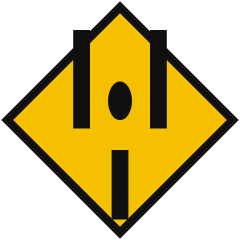
Show answer
Answer D: Driving on the far side of the separation, against the flow
Once the two directions are separated, each roadway carries one-way traffic, so crossing to the other side means driving into oncoming vehicles.
-
15. You reach a stop-controlled intersection at the same time as a driver on your left, but that driver is already moving through the crossing. Who goes first?
Show answer
Answer C: The driver who is already inside the intersection
A vehicle already in the intersection has the right of way, and the rule about yielding to the right applies only before anyone has entered.
-
16. May you exceed the posted speed limit in order to complete a pass?
Show answer
Answer C: No, the posted limit applies while you are passing too
The limit does not lift for passing; if you cannot complete the pass within it, there is not enough room and you should stay back.
-
17. What happens to a Kansas farm permit once the division learns the holder has been in two or more chargeable accidents?
Show answer
Answer D: The permit is suspended and may not be reinstated for one year
K.S.A. 8-296 directs the division to suspend the farm permit on satisfactory evidence of two or more chargeable accidents, and the permit stays suspended for one year.
-
18. At which location is this sign normally installed?

Show answer
Answer D: Facing traffic that could turn into a one-way roadway or ramp against the flow
It is posted where a driver could otherwise enter a ramp or a one-way roadway from the wrong end, so it faces exactly the traffic that has to be kept out.
-
19. A yellow diamond shows a car with wavy lines behind its rear tires. What is the warning?
Show answer
Answer D: The surface loses grip badly when it is wet
The slippery when wet sign marks a stretch where traction falls off sharply in rain, so speed and braking must be reduced well in advance.
-
20. The driver of a slow farm vehicle moves partly onto the shoulder and waves you past. Who is responsible for the pass?
Show answer
Answer A: You are, so pass only if you can see that the road is clear
A courtesy wave is not a traffic control, and the driver who changes lanes is the one answerable for the maneuver.
-
21. How long is the ignition interlock restriction after a Kansas driver serves the suspension for a first test failure with nothing else on the record?
Show answer
Answer C: 180 days
K.S.A. 8-1015 restricts the driver to an interlock equipped vehicle for 180 days after the 30 day suspension, unless the record shows one of the listed prior convictions.
-
22. You have begun to move into the next lane when the gap you were aiming for closes. What is the safest action?
Show answer
Answer C: Return to your own lane, cancel the signal and wait for a better gap
An unfinished lane change leaves you in a space that no longer exists, and the lane you came from is still yours.
-
23. You are driving on a divided highway and see a solid yellow line along the left side of your lanes. What does it tell you?
Show answer
Answer D: It marks the left edge of the roadway for your direction
On a divided highway or a one-way roadway, the left edge of the traveled way is marked with a solid yellow line.
-
24. A driver's blood alcohol concentration is below the legal limit, but the driver is visibly impaired. Can the driver be arrested?
Show answer
Answer C: Yes, driving while impaired by alcohol is an offense at any concentration
The per se figure, 0.08 percent in most states and 0.05 percent in Utah, is the level at which impairment is presumed. Impairment shown by driving behavior and field tests is enough on its own, because alcohol affects skills well before that number.
-
25. On a long drive you notice repeated yawning, missed exits and drifting toward the lane line. What should you do?
Show answer
Answer C: Pull off at a safe place and sleep, or change drivers
Those are warning signs that sleepiness is already interfering with driving, and only rest restores alertness. Fresh air, music and caffeine do not reverse it.