
Kansas DOV Permit Practice Test 17
- Questions25
- Correct to pass20
- Passing score80%
- Minimum age14 years
-
1. The low sun is directly ahead and glare makes it hard to see. What should you do?
Show answer
Answer C: Slow down, use the sun visor or sunglasses, and increase following distance
Sun glare can hide pedestrians, brake lights and signals. Reducing speed and adding space gives you time to react to what you cannot yet see.
-
2. The gates at a railroad crossing are down, and you can see that the road beyond them is clear. What is the correct action?
Show answer
Answer A: Wait until the gates rise completely and the lights go out
Lowered gates mean rail traffic is expected, and driving around them removes the only protection the crossing provides.
-
3. What most often starts a rear wheel skid?
Show answer
Answer A: Too much speed, braking or acceleration for the grip available
A skid begins when what you ask of the tires exceeds what the surface can give, which is usually a matter of speed and of how abruptly you use the controls.
-
4. You must cross a stretch of water lying across the road that you know is shallow. What is the right technique?
Show answer
Answer A: Slow down before you reach it and cross steadily in a low gear
Slow before the water, then keep a steady low speed so you do not throw water over the engine or lose steering. Test the brakes gently once you are through.
-
5. You have just been involved in a crash on a city street. Which sequence of first steps is correct?
Show answer
Answer A: Stop where you are, check everyone for injuries, and then make the scene safe
You are required to stop, and the first priority at the scene is people, followed by preventing a second collision.
-
6. An arrow panel at a work zone displays a flashing arrow pointing to the left. What does it require?
Show answer
Answer C: Move out of the closed lane into the lane on the left
A flashing or sequential arrow on an arrow panel directs traffic out of a closed lane and into the lane the arrow points to.
-
7. The trapezoid sign shape is associated with
Show answer
Answer C: recreational and cultural interest area signing
The trapezoid is used for recreational and cultural interest area guide signs and for national forest route markers.
-
8. A steady red arrow is displayed for your left-turn lane at a two-way intersection. What must you do?
Show answer
Answer C: Stop and remain stopped until an indication permits the turn
A steady red arrow prohibits the movement it points to, so the driver stops and waits for a green arrow, a flashing yellow arrow or another indication that permits the turn.
-
9. You and an opposing driver reach a four-way stop at the same time and both of you are turning right. What should happen?
Show answer
Answer C: Both may turn at the same time into their own lanes
Two opposing right turns take drivers into different lanes without crossing, so both can proceed together once pedestrians are clear.
-
10. What does the implied consent law mean for drivers?
Show answer
Answer D: By driving, you have agreed to a chemical test if lawfully arrested for impaired driving
Holding a license and driving on public roads is treated as consent to breath, blood or urine testing when an officer has grounds to arrest you. Refusing normally brings its own license penalties.
-
11. You have stopped on the shoulder of a busy freeway with a flat tire that you cannot change safely. Where should you and your passengers wait?
Show answer
Answer A: Well away from the traffic side, behind a barrier or up the bank if there is one
People struck on the shoulder are a common cause of roadside deaths, so wait away from the traffic side and behind any barrier.
-
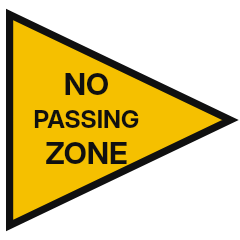
12. Why would a restriction like this one be applied to a stretch of road?
Show answer
Answer A: Because there is not enough visible road ahead to complete a pass safely
Limits on overtaking are set where a hill, a curve or an obstruction leaves too little sight distance for a driver to pull out, pass and return before meeting oncoming traffic.
-
13. On a Kansas two-lane road where changing lanes is impossible, what must a driver do when approaching a stopped vehicle displaying hazard warning lamps?
Show answer
Answer D: Proceed with due caution, reduce speed and keep a safe speed for conditions
K.S.A. 8-15,116 requires a driver who cannot safely change lanes to proceed with due caution, slow down and maintain a speed that is safe for the road, weather and traffic.
-
14. Which practice matches current child passenger safety guidance?
Show answer
Answer D: Keep a child rear facing until the top height or weight limit of the seat is reached
A rear facing seat spreads crash forces across the child's whole back, so it should be used as long as the seat allows, and never in front of an active passenger air bag.
-
15. You are driving slower than the general flow on a multilane highway. Which lane should you use?
Show answer
Answer D: The right lane, keeping the left lanes free for faster traffic and passing
Slower traffic must keep right so that faster vehicles and overtaking traffic can use the left lanes without weaving between lanes.
-
16. The street you are turning right onto has a bike lane along its right edge. Where should your vehicle end up?
Show answer
Answer B: In the first traffic lane to the left of the bike lane
A bike lane is not a travel lane for motor vehicles, so the nearest lane you may finish a right turn in is the first general traffic lane beside it.
-
17. You are stopped in a shared through and right-turn lane with your right signal on, and a bicyclist rides up along your right side. What should you do?
Show answer
Answer A: Let the bicyclist clear the intersection or move ahead before you turn
A cyclist alongside your right side is in the path your turn will sweep across, so wait until that space is clear before turning.
-
18. You reach the end of the acceleration lane and there is still no gap in the traffic. What should you do?
Show answer
Answer B: Slow down and merge behind the traffic rather than forcing your way in
Merging behind the traffic costs you only a little speed, while forcing into a space that is not there puts you alongside a vehicle with nowhere to go.
-
19. Which clue tells you that a parked vehicle is about to pull into traffic?
Show answer
Answer D: Exhaust smoke, brake lights, front wheels turned out or a driver in the seat
A running engine, lit brake lights, turned wheels or a person behind the wheel all mean the vehicle may move. Slow down and give it room.
-
20. A diamond-shaped sign is used to
Show answer
Answer A: warn of a condition on or next to the road that may call for caution
The diamond is the standard shape of the warning series, which alerts drivers to conditions that would otherwise not be obvious in time to react.
-
21. You are about to pass another vehicle at night with your high beams on. What should you do?
Show answer
Answer C: Switch to low beams as you come up behind it and while you are alongside
High beams shining into the mirrors of the vehicle ahead blind the very driver whose reaction you depend on during the pass.
-
22. What is the minimum age for a Kansas restricted class C driver's license?
Show answer
Answer B: 15 years
K.S.A. 8-2,101 allows a restricted class C or class M license at 15 years of age for an applicant who has completed approved driver training and held an instruction permit for at least one year.
-
23. For the first six months after turning 16, when may a Kansas restricted licensee drive without one of the listed exceptions?
Show answer
Answer B: Only from 5 a.m. to 9 p.m.
K.S.A. 8-2,101 limits a 16 year old restricted licensee to driving from 5 a.m. to 9 p.m. for six months, apart from trips connected with work, school activities, religious activities, or driving accompanied by a qualifying adult.
-
24. An orange background with a black legend on a sign indicates
Show answer
Answer B: a temporary traffic control or work zone situation
Orange is reserved for temporary traffic control signing, so an orange sign means conditions have been altered for work or another temporary operation.
-
25. A broken white line separates your lane from the lane beside it. What does it indicate?
Show answer
Answer C: Both lanes carry traffic in the same direction and lane changes are permitted
White lines separate lanes of traffic moving in the same direction, and a broken white line means changing lanes across it is permitted when it is safe.