
Kansas DOV Permit Practice Test 13
- Questions25
- Correct to pass20
- Passing score80%
- Minimum age14 years
-
1. Two left-turn lanes are marked at the intersection and you are in the left one. What must you do?
Show answer
Answer A: Stay in your own lane all the way around the turn
With dual turn lanes each driver must hold a lane through the whole turn and come out in the matching lane of the new street.
-
2. What does a NARROW BRIDGE warning sign tell a driver?
Show answer
Answer A: The bridge is tighter than the road leading up to it
A narrow bridge still carries both directions, but with much less clearance than the approaches, so drivers should slow and hold their lane position carefully.
-
3. Before making a right turn at an intersection, what should you check besides oncoming traffic?
Show answer
Answer B: Your right blind spot and the crosswalk, for cyclists and pedestrians
Right turns often catch a cyclist or a pedestrian coming up on the right, so check the blind spot and the crosswalk before you turn.
-
4. An overhead lane-use control signal shows a steady red X above the lane you are traveling in. What does it require?
Show answer
Answer D: Leave that lane, because it is closed to you
A steady red X means road users are not permitted to use the lane beneath it, so you must move into a lane that is open.
-
5. The brake pedal goes to the floor and the vehicle does not slow. What should you try first?
Show answer
Answer C: Pump the pedal quickly to try to build pressure
Most vehicles have a split braking system, so rapid pumping can often build enough pressure to slow you. If it does not, use the parking brake gradually.
-
6. A yellow diamond showing the silhouette of a deer warns that
Show answer
Answer D: large animals may cross the road in that area
The sign marks a stretch where animals are known to cross, so drivers should reduce speed and scan both roadsides, especially around dawn and dusk.
-
7. Your vehicle does not have antilock brakes and you must stop quickly on a slippery road. What is the correct technique?
Show answer
Answer B: Apply the brakes firmly without locking the wheels, releasing slightly if they lock
Locked wheels slide and cannot steer. Squeezing the brakes to just short of lockup, and easing off if they lock, gives the shortest stop with control.
-
8. You are in the middle of an intersection when you hear a siren and see an emergency vehicle approaching. What should you do?
Show answer
Answer A: Keep going, clear the intersection, then pull to the right and stop
Stopping inside an intersection blocks the emergency vehicle. Clear the intersection first, then pull over to the right and stop.
-
9. What do flashing yellow lights on a school bus mean?
Show answer
Answer A: The bus is about to stop to load or unload, so prepare to stop
The amber lights are the warning phase that comes before the red lights and the stop arm, so drivers should slow down and get ready to stop.
-
10. An oncoming vehicle at night has its high beams on and you are being dazzled. Where should you look?
Show answer
Answer A: Toward the right edge of your lane
Looking toward the right edge line keeps you on course while sparing your eyes the worst of the glare. Slow down and do not retaliate with your own high beams.
-
11. What is the only reliable remedy for a driver who is sleepy?
Show answer
Answer A: Sleep
Caffeine, fresh air and noise may make you feel alert for a few minutes, but they do not remove the need for sleep. Stop somewhere safe and rest.
-
12. A loaded truck is coming up an entrance ramp as you approach in the right lane of the freeway. What is the most helpful action?
Show answer
Answer A: Adjust your speed to open a gap for it
A heavy vehicle accelerates slowly, so opening a gap or moving over costs you seconds and saves the truck driver from being forced to stop on the ramp.
-
13. Why is it useful to watch the vehicle two or three places ahead of you?
Show answer
Answer C: You get an earlier warning of slowing traffic than brake lights give
Trouble travels back through a line of traffic, so seeing it start several vehicles ahead gives you a head start on braking.
-
14. What may a Kansas court impose on a first conviction of reckless driving?
Show answer
Answer B: Five to 90 days in jail, or a fine of 25 to 500 dollars, or both
K.S.A. 8-1566 punishes a first reckless driving conviction with five to 90 days imprisonment, a fine of 25 to 500 dollars, or both.
-
15. At a four-way stop another driver pulls out ahead of you when it was clearly your turn. What is the correct response?
Show answer
Answer B: Let that driver go through, then take your turn when the way is clear again
Right of way is something you give, never something you take, so yielding to a driver who takes it wrongly avoids a crash you would otherwise share.
-
16. A yellow diamond reading DIP warns a driver about
Show answer
Answer A: a short, sharp depression in the road surface
A dip is an abrupt low point that can jolt a vehicle or scrape its underside, so speed should be reduced before reaching it.
-
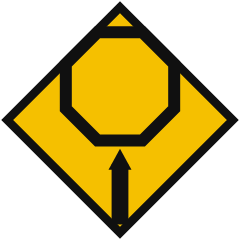
17. What is the driver expected to do after passing this sign?
Show answer
Answer A: Begin slowing so that a complete stop can be made at the intersection ahead
It is used where the control at the intersection stays hidden until late, so braking should begin here rather than at the stop line.
-
18. At the scene of a crash you were part of, what are you required to do besides stopping?
Show answer
Answer B: Give your name, your address and vehicle details, and help anyone who is hurt
Every state requires drivers involved in a crash to identify themselves and to render reasonable aid to anyone injured.
-
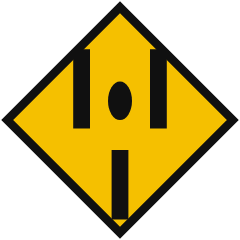
19. What must a driver be ready for beyond this sign?
Show answer
Answer C: Vehicles approaching from the opposite direction in the next lane over
The separation between the two directions runs out, so from that point oncoming vehicles share the same pavement and the driver has to keep right.
-
20. A vehicle coming toward you has drifted into your lane. What should you do?
Show answer
Answer D: Slow down, sound the horn, flash your lights and steer to the right if possible
Moving right gives the other driver space to recover and keeps you out of the lane they are most likely to return to. Braking reduces the force of any impact.
-
21. What are front fog lights for?
Show answer
Answer D: Adding a low, wide beam close to the car when visibility is poor
Fog lights throw a low, wide beam under the fog, which is why they are mounted low and are used only in poor visibility.
-
22. What is a designated driver?
Show answer
Answer A: Someone who agrees to drink nothing at all
A designated driver drinks no alcohol whatsoever, because any amount begins to affect judgment and the whole point is a sober driver.
-
23. Why does a dirty windshield matter much more at night than during the day?
Show answer
Answer C: Dust and streaks scatter oncoming light and increase glare
Film and streaks on the glass spread every oncoming headlight into a star of glare, so clean the inside as well as the outside before a night trip.
-
24. A deer has just crossed in front of you on a stretch signed for animal crossings. What is the best assumption?
Show answer
Answer B: More animals are likely to follow the first one
Deer travel in groups, so one animal crossing usually means others are about to follow, and a driver should slow and keep scanning both shoulders.
-
25. What should a driver do first after passing this sign?
Show answer
Answer A: Move into the right-hand lane and stay there
Traffic returns to two-way operation, so the driver keeps to the right of the centerline and stops treating the left side as available.